

You need a digital marketing agency because your time as a business owner has a cost. Every hour spent learning SEO, configuring ad campaigns, managing social channels, and interpreting analytics is an hour not spent running the business you built. An agency brings years of built expertise — so you are investing in compounding results, not in the learning curve itself.
Key Takeaways
- Every hour a business owner spends on SEO, ad campaigns, or social channels is an hour not available for the decisions only they can make — the opportunity cost of DIY digital marketing is higher than the agency fee in most cases.
- Organic search drives 53.3% of all website traffic — more than three times the share of paid search — making it the highest-leverage channel to build consistently, with results that compound rather than reset when spend stops.
- A boutique agency gives you direct access to the people doing the work, not an account manager relaying messages to a junior team — for small and medium businesses, that direct access is where the value difference shows.
- The best agencies run a proper diagnostic before proposing anything — auditing the website, analytics configuration, and competitive landscape before recommending a direction, not after the contract is signed.
- A staged model — technical foundations and tracking first, then content and authority building — consistently outperforms starting with content production before the infrastructure is in place to measure what it produces.
Most business owners who attempt their own digital marketing end up doing fragments of each discipline — posting when time allows, running ads without conversion tracking, publishing content without a keyword framework. The problem is not a lack of effort. It is the time required to stay current across SEO, paid media, content strategy, social platforms, and analytics simultaneously — while also running a business.
For businesses exploring digital marketing services for small business, the barrier is rarely tools or information. Both are freely available. The real cost is attention — the compounding opportunity cost of time diverted from the work only the business owner can do to disciplines that take years to master. The digital marketing agency market has grown substantially as more businesses recognise this. IAB Australia found that digital advertising spend reached $18.4 billion in 2025. Search advertising alone accounted for $8.0 billion — an 11.5% increase year-on-year.
A modern internet marketing service spans more disciplines than most people realise. Content marketing agency SEO — where editorial content, technical optimisation, and link authority function as a single system — is one example. Done well, it builds compounding organic visibility that competitors find difficult to displace. This guide covers what agencies actually do, what they cost, and what to look for.
What Makes a Boutique Digital Marketing Agency Different
A boutique digital marketing agency gives clients senior-level attention rather than a junior account manager. Work is customised, not templated. Communication runs directly with the people executing the strategy — not filtered through layers of management.
Large agencies distribute clients across layered teams with standardised processes. In practice, advice gets filtered before it reaches execution, and adjustments take longer to implement. A boutique model eliminates that distance. Recommendations are specific to each client’s market and stage, and the client always knows what is being done and why.
Why an Online Boutique Marketing Agency Understands Your Market
An online boutique marketing agency combines strategic capability with genuine fluency in niche consumer markets. In these categories — fashion, lifestyle, wellness, homewares — brand identity and emotional resonance drive purchasing decisions as much as price does. Generic marketing approaches produce generic results. The strategy, content, channels, and targeting all need to reflect the specific audience.
Agencies working consistently in these markets bring knowledge no campaign brief can replicate. They know:
- Which content formats drive engagement in each category.
- Which platforms their audiences actually use.
- How seasonal cycles affect buying behaviour.
- What brand positioning the market rewards.
That accumulated judgement is part of what you are purchasing — not just execution, but expertise built through direct experience.

TriOrbit Digital
Is your business ready to stop improvising and start building something that compounds?
TriOrbit Digital builds structured, scalable digital growth systems for small to medium businesses — connecting SEO, content, social media, and paid advertising into a single, compounding strategy. If you want to understand what a structured approach could look like for your business, let’s start the conversation.
Why Small Businesses Need a Digital Marketing Agency More Than They Realise
The relationship between a digital marketing agency and a small business is almost always more valuable than clients initially expect. The underlying need is almost always larger than it first appears.
Most small businesses underestimate how much coordinated effort produces the results their more visible competitors appear to achieve with ease. Maintaining all of the following at a competitive level requires sustained, skilled effort — not a single campaign or a lucky month:
- Consistent organic search rankings.
- A social media presence that builds a genuine audience.
- A functioning lead generation system.
- Paid advertising that does not haemorrhage budget.
Small business digital marketing services that work are built around systems, not sporadic activity. The common alternative looks like this:
- Posting on social media when inspiration strikes
- Running Google Ads without conversion tracking
- Publishing content with no strategic keyword framework
This produces the illusion of marketing activity without the substance of a growth strategy.
Working with a structured agency shifts the model from reactive to systematic. Every action connects to a measurable outcome. Every outcome informs what happens next. The whole effort builds progressively — rather than resetting each quarter.
What do digital marketing agencies do?
The full scope often surprises business owners who have only seen one or two channels in isolation. A well-structured agency manages all of the following simultaneously:
- Keyword research and competitive analysis.
- Technical SEO audits and implementation.
- On-page optimisation.
- Content planning and production.
- Link building.
- Social media strategy and management.
- Paid media campaigns.
- Email marketing.
- Conversion tracking.
- Monthly performance reporting.
The visible result is traffic, leads, and enquiries. The invisible infrastructure behind those outcomes is the coordination that makes them repeatable.
For a practical starting point, small business digital marketing services built around a staged growth model offer the clearest path in without overcommitting early.
What an AI Digital Marketing Agency Brings to the Table
The AI digital marketing agency represents a genuine shift in what agencies can deliver. AI tools have changed the speed and scale of work across every discipline — content production, keyword analysis, audience segmentation, ad creative testing, and performance reporting.
Agencies that have integrated AI thoughtfully into their workflows produce more in less time without sacrificing strategic quality. For clients, the practical benefit is better economics — more output within the same budget. AI marketing tools now assist with:
- Content brief generation and competitive gap analysis.
- Ad copy variations and creative testing.
- Email sequence automation through platforms like Brevo.
- Performance reporting and anomaly detection.
What AI cannot replace is strategic judgement. Knowing which channels to prioritise, how to position a brand in a competitive market, and how to build a content architecture that compounds — these decisions still require human expertise. An AI SEO service does not remove the strategist from the equation. It gives them better tools. Agencies combining deep expertise with AI-assisted execution represent the current frontier of what digital marketing delivers for growing businesses.
Why Small Businesses Benefit from a Dedicated Social Media Agency
A social media agency for small business closes one of the most consistent gaps in small business marketing: the gap between knowing that a consistent, quality social presence matters and actually sustaining one.
Running social media well is a full-time discipline. A dedicated agency manages:
- Ongoing content creation and calendar management.
- Platform-specific formatting and scheduling.
- Community engagement and direct message responses.
- Performance analysis and strategy adjustment.
Every one of these tasks suffers visibly when treated as an afterthought.
A dedicated agency replaces reactive posting with systems that make consistency achievable. Content is developed around what the business’s ideal customers actually engage with — not generic industry material that fills a feed without building a following. Tools like Canva accelerate visual asset creation, but the strategy that determines what to create, for whom, and why is the real value.
What is a social media marketing agency?
In its fullest form, a social media marketing agency also includes social listening — monitoring conversations about the brand and its market to inform both content and broader strategy. A well-managed social media management service builds an audience that a larger ad budget alone cannot buy, because the engagement is genuine and the relationship is actively built over time.
How Much Does It Cost to Hire a Digital Marketing Agency?
Agency fees depend on scope, service model, and what the agency is being asked to deliver. Retainers for small to medium businesses typically range from a few hundred dollars per month for focused single-channel management to several thousand for full-service, multi-channel strategy and execution. Project-based work — a website redesign, a content audit, a brand strategy — is typically scoped and priced separately.
The more useful question is not what the agency charges per month. It is what the investment is structured to produce and how that will be measured. A transparent agency is specific about:
- What will be delivered each month.
- How performance will be reported.
- What success looks like at three, six, and twelve months.
Vague commitments to “improve your visibility” with no defined metrics are a reliable early warning sign. If an agency cannot explain how they will measure success before you sign, they will not be able to demonstrate it once the retainer is running.
A sound first step is a structured onboarding phase — an SEO Starter Package. It audits your current digital position, sets up tracking through Google Analytics 4 and Google Search Console, maps your keyword opportunities, and produces a clear roadmap before significant spend begins. A well-built website on a fast platform like GeneratePress is often part of what that audit examines. Page speed directly influences both SEO rankings and conversion outcomes.
What a Local SEO Agency Does for Your Search Visibility
A local SEO agency improves your visibility in the results that appear when someone searches for a service near them. These results are governed by different signals from standard organic search.
The key local ranking signals include:
- Google Business Profile completeness and accuracy.
- Citation consistency across directories.
- Review volume and recency.
- Localised on-page signals.
Think with Google research shows that 76% of nearby smartphone searches result in a business visit within 24 hours — and 28% result in a purchase. These are the moments a local SEO agency is built to capture.
An SEO and internet marketing company that covers both the technical and content dimensions of local visibility builds these signals correctly. It also maintains them as the local algorithm evolves. A well-optimised Google Business Profile drives calls, direction requests, and website visits. Managed through a dedicated Google Business Profile Management service, it reaches searchers who are already close to a purchase decision. BrightLocal‘s 2024 survey found that 88% of consumers would use a business that replies to all its reviews. Just 47% would use one that responds to none. Review management is a direct driver of customer acquisition — not merely reputation.
Local SEO requires ongoing attention. Google’s local algorithm updates regularly, competitor activity shifts the landscape, and review patterns change over time. An agency actively managing your local presence ensures visibility compounds rather than drifts. Businesses investing consistently in local search for twelve to eighteen months typically find their position has become significantly harder for competitors to displace.

How a PPC Management Agency Maximises Your Paid Advertising Return
Paid search is not inherently expensive — it becomes expensive when managed without the right structure. A PPC management agency builds what most self-managed accounts lack:
- Tightly grouped keyword sets matched to search intent.
- High-quality ad copy aligned to each ad group.
- Landing pages built to convert each specific audience.
- Conversion tracking configured through Google Ads and Google Analytics 4.
- Ongoing bid management driven by real performance data.
A Google PPC agency with specialist capability also operates at a strategic level. They know when to concentrate budget on high-intent terms and when to cut spend on non-converting keywords. They also know how to build a campaign architecture that improves over time. A Google Ads services agency worth working with will:
- Apply negative keyword lists rigorously.
- Manage match types with discipline.
- Analyse search term reports regularly to keep budget reaching the right audience.
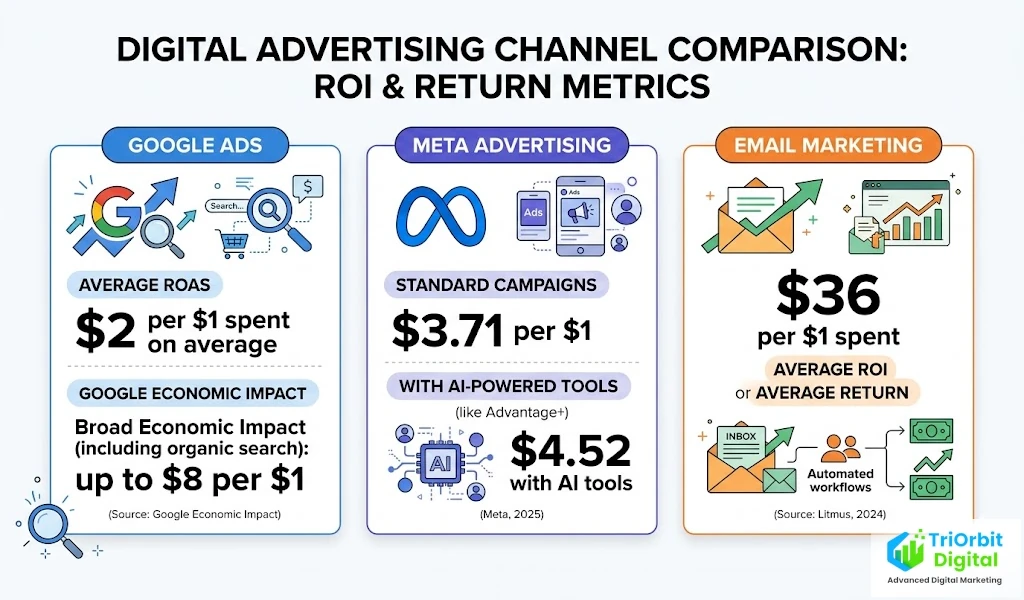
Google’s economic impact data estimates businesses earn an average of $2 for every $1 spent on Google Ads. Including organic search, that figure rises to $8 in combined value. The same budget produces vastly different outcomes depending on management quality. An unmanaged campaign often loses money. A well-managed one generates a consistent pipeline of qualified enquiries. A PPC marketing company with genuine expertise will frequently recover its own fee through budget efficiency improvements alone.
The Long-Term Case for Working with an Organic Search Engine Optimisation Company
An organic search engine optimisation company builds a long-term asset, not a short-term result. Organic rankings earned through genuine SEO do not disappear when you pause spending — they compound. According to BrightEdge research, organic search drives 53.3% of all website traffic. That is more than three times the share of paid search (15%) and more than ten times the contribution of social media (5%). No paid channel offers anything comparable in terms of long-term return.
SEO online marketing services work across four interconnected layers:
- Technical SEO — ensuring search engines can crawl and index your site correctly, using tools like Rank Math for on-page signal management.
- On-page SEO — aligning content with the intent behind target searches, delivered through a dedicated on-page SEO service.
- Content marketing — creating articles and pages that capture long-tail traffic and build topical authority.
- Link building — earning external signals that confirm your site’s credibility to search engines, through specialist link building services.
Each layer supports the others. When all four operate together, the compounding effect is substantial.
SEO vs digital marketing — which is better?
This is a common misframing. SEO is not an alternative to digital marketing — it is one of its most powerful components. Consistent organic investment over two to three years means a significant portion of qualified traffic arrives at no marginal cost per visit. That structural advantage is not available to businesses that treat organic search as optional.
Businesses starting this journey should begin with a keyword research service and competitor research before committing to a content strategy. Building on accurate data avoids producing content that ranks well for terms no customer is actually searching.

What the Best Digital Marketing Agencies Have in Common
The best digital marketing agency for any given business is not necessarily the largest or most decorated. It is the one that demonstrates genuine understanding of your market, communicates with transparency, and structures the engagement around measurable outcomes — not vanity metrics.
Strong agencies begin every client relationship with a proper diagnostic. Before proposing anything, they complete:
- An audit of the current website.
- An assessment of the existing analytics configuration.
- A competitive landscape analysis.
- A clear picture of keyword opportunities.
Agencies that propose solutions before running this diagnostic are proposing blind. The tools matter too. Strong agencies work with:
- LowFruits for identifying low-competition keyword opportunities.
- Google Search Console for understanding current search performance.
- Salesforce or equivalent CRM platforms to connect marketing activity to actual revenue.
These tools connect the diagnosis to the strategy — and the strategy to measurable revenue outcomes.
Strong agencies are also specific about measurement. Rather than reporting on impressions and follower counts, they connect their work to outcomes:
- Lead volume.
- Organic traffic growth.
- Cost per acquisition.
- Revenue influenced by the channels they manage.
The agencies that set clear KPIs before the engagement begins — and hold themselves accountable in monthly reporting — demonstrate value rather than claim it. An SEO Visibility Package with defined benchmarks and transparent reporting gives businesses a real view of progress from the start.
Finally, the best agencies structure engagements progressively. A staged model — foundations and tracking first, then content creation and authority building, then long-term SEO maintenance — produces more consistent results. Each stage delivers a clearer return. Committing to a full-service retainer before the foundations are in place is one of the most common reasons agency relationships underperform.
What a Social Media Ads Agency Does That Generic Management Cannot
A social media ads agency operates at a different level of precision from an agency that includes paid social as one service among many. Running paid social profitably — across Meta, Instagram, LinkedIn, and TikTok — requires a specific and constantly evolving skill set:
- Audience architecture and targeting strategy.
- Creative strategy and copy-visual testing frameworks.
- Pixel configuration and retargeting architecture.
- First-party data strategies that do not depend on deprecated tracking signals.
- Continuous optimisation based on real performance data.
The digital marketing agency for social media landscape has changed significantly in recent years. Privacy changes across iOS devices, ongoing platform algorithm updates, and increasing competition in ad auctions have made paid social substantially harder to manage profitably. Agencies that have adapted are producing results that less-prepared competitors struggle to replicate. The adaptation centres on first-party data strategies and audience segmentation independent of deprecated tracking. Meta‘s own 2025 data shows that advertisers using AI-driven tools earn $4.52 for every $1 spent. Those who do not earn $3.71. Meta Ads Manager, configured by a specialist team, offers targeting precision and creative iteration speed that require consistent testing discipline to achieve.
A dedicated ecommerce agency or Shopify SEO agency brings specific platform knowledge that generic digital marketing partners rarely match. Paid social works in tandem with product catalogue feeds, dynamic remarketing, and sequential creative strategies to guide shoppers from awareness to purchase. A dedicated social media advertising agency understands this full ecosystem. It delivers outcomes a Google marketing agency or general digital partner applying the same budget rarely matches. Clients of an SEO agency for ecommerce also benefit from understanding how paid social and organic search reinforce each other. Organic credibility amplifies paid campaign performance, particularly during seasonal peaks and product launches.

How to Choose a Digital Marketing Agency That Fits Your Business
Knowing how to choose a digital marketing agency starts with a small number of questions every credible agency should answer clearly before you engage. The presence or absence of clarity in those answers tells you what the relationship will actually look like.
Start with transparency about process. A credible marketing agency for small business will explain specifically:
- What they propose to do and why.
- What will be delivered each month.
- How performance will be reported.
- What success looks like at three, six, and twelve months.
Vague proposals built around “comprehensive digital strategies” with no specific deliverables are a reliable warning sign. An agency that cannot define what they will deliver will not be able to demonstrate it once the retainer is running. Ask for specifics before signing anything.
Ask how they approach the start of a new engagement. The question of when to hire a digital marketing agency is partly about readiness — and a good agency asks these questions before proposing anything:
- Is your website technically sound?
- Is your Google Business Profile complete and verified?
- Is your analytics capturing the events that actually matter for your business?
Agencies that present a proposal before asking these questions should be evaluated with care.
Look for a phased, structured approach. The digital marketing services for small business that produce the most consistent results move through clearly defined stages:
- Foundations and tracking.
- Organic visibility and keyword strategy.
- Content authority and link development.
- Ongoing refinement and maintenance.
Skipping foundations to accelerate content production is one of the most common reasons agency relationships underperform their potential.
If local visibility is a priority, look for demonstrable experience in local SEO specifically. The best local SEO expert or agency with a local track record will show you specific results for comparable businesses — not capability claims. Our fashion stylist case study is one example of how a structured approach produces measurable results for a niche service business.
The real question is not just which agency, but why choose a digital marketing agency that thinks in systems rather than services. Businesses that see the strongest results commit to a structured process over a meaningful timeframe. They work with agencies that build that structure deliberately from day one.
TriOrbit Digital structures every engagement as a staged, scalable digital growth system — starting with proper foundations and building progressively through content, authority, and automation. If you want to understand what a structured approach could look like for your business, a free discovery call is the right place to start.
Taking the First Step Toward Structured Digital Growth
The gap most businesses face is not understanding — it is structure. Most business owners know that digital marketing matters. What they lack is the coordinated infrastructure to execute it consistently and measure what it actually produces.
A well-chosen agency closes that gap. Not by taking marketing entirely off your plate, but by building the system that makes it work without requiring your constant attention to sustain it. That distinction matters because it means results compound rather than plateau. Each month builds on the last. Each channel reinforces the others. Over time, the asset becomes genuinely difficult for competitors to displace.
If the ideas in this guide resonate with where your business is right now, the most productive next step is a conversation. A free strategy call takes your current digital position, your goals, and your timeline and turns them into a clear picture of what a structured approach would realistically produce for you.
Frequently Asked Questions
What does a digital marketing agency actually do?
A digital marketing agency manages the channels and strategies that drive online visibility, traffic, and leads. This typically spans SEO, content creation, social media, paid advertising, email marketing, and conversion tracking — coordinated as a single system, not isolated tactics.
Most business owners see only the surface outputs: more traffic, better rankings, more enquiries. Behind those results is a continuous operation — keyword research, technical audits, content planning, campaign management, and performance reporting. An agency provides the team and infrastructure to sustain all of it without the business owner managing each discipline separately.
How long does it take to see results from a digital marketing agency?
It depends on the channel. Paid search can produce enquiries within days of a well-structured campaign going live. Organic SEO typically takes three to six months before meaningful ranking movement is visible, and twelve to eighteen months to compound into a reliable traffic source. Social media sits between the two — audience growth takes time, but engagement can improve within weeks of consistent activity.
The timeline also depends on the starting point. A business with no analytics, no keyword strategy, and a technically weak website needs a foundations phase before results are possible. Agencies that promise fast organic results without this groundwork are cutting corners that cost more time later.
What is the difference between a boutique and a large digital marketing agency?
A boutique agency gives clients direct access to senior practitioners. The people setting strategy are the same people executing it. Communication is faster, advice is more specific, and recommendations are shaped around each client’s particular market rather than a standard playbook.
Large agencies distribute work across layered teams. A senior strategist sets direction, but execution passes through account managers, specialists, and coordinators — each adding distance between the client and the work. This structure works well for enterprise clients with complex requirements. For small to medium businesses, the boutique model almost always produces a closer and more productive working relationship.
When is the right time for a small business to hire a digital marketing agency?
The right time is when the business has a clear service or product to sell and is ready to invest consistently in growth. An agency can accelerate a working business model. It cannot substitute for one.
Having some basic infrastructure in place helps: a functional website, a verified Google Business Profile, and a clear sense of which customers you are trying to reach. An SEO Starter Package is often the most productive way to begin — it establishes proper tracking and maps keyword opportunities before significant spend is committed.
Is SEO better than paid advertising for a small business?
They serve different purposes, which is why framing it as a competition misses the point. Paid advertising delivers traffic immediately but stops the moment spend pauses. SEO builds a compounding asset — organic rankings that continue delivering traffic without a cost per click. Over a long enough timeframe, the economics of organic search are substantially better than any paid channel.
For most small businesses, the practical answer is to run a focused paid campaign for early enquiries while the organic strategy builds. Once organic traffic reaches a meaningful volume, reliance on paid channels can reduce without sacrificing lead flow. That typically happens after twelve to eighteen months of consistent investment. The two channels also reinforce each other — strong organic credibility improves paid campaign performance, because searchers who have already seen the brand organically are more likely to convert.
How do I know if my digital marketing agency is delivering results?
A reliable agency sets specific, measurable KPIs before the engagement begins. These should include organic traffic growth, keyword ranking movement, lead volume, and cost per acquisition for any paid channels. If an agency cannot define success in concrete terms at the start, it will not be able to demonstrate it later.
Monthly reporting should connect activity to outcomes. A report that lists tasks completed without showing what those tasks produced is not a results report — it is a timesheet. Ask specifically how each activity contributed to the KPIs agreed at the start. An SEO Visibility Package with built-in benchmark reporting gives a clear, consistent view of progress — straightforward to read and easy to hold the agency accountable against.
Can a small business afford to work with a digital marketing agency?
Agency pricing varies widely depending on scope and service model. Single-channel management — local SEO or social media only — can start at a few hundred dollars per month. Full-service, multi-channel strategy and execution typically ranges from one to several thousand per month for small to medium businesses.
The more useful framing is return rather than cost. A well-managed paid search campaign often recovers its own management fee through budget efficiency improvements alone. Organic SEO compounds over time — the traffic it delivers after eighteen months arrives at no marginal cost per visit. Measuring the investment against what it produces, rather than the monthly fee in isolation, gives a more accurate picture of affordability.
What questions should I ask a digital marketing agency before signing?
Start with transparency about process. Ask what specifically will be delivered each month, how performance will be reported, and what success looks like at three, six, and twelve months. A credible agency answers these questions clearly before the contract is signed. Vague answers at this stage reliably predict vague reporting later.
Ask how they approach a new engagement. Do they audit the website, analytics setup, and competitive landscape before proposing anything? Or do they present a proposal before understanding your current position? Agencies that propose solutions without completing this diagnostic are proposing blind.
Ask for examples of comparable clients — businesses of similar size in similar markets. Capability claims are easy to make. Specific, verifiable results from real clients are not.
How does an AI digital marketing agency differ from a traditional one?
An AI-integrated agency uses artificial intelligence to increase the speed and scale of work. This spans every discipline — content production, keyword analysis, audience segmentation, ad creative testing, and performance reporting. The practical benefit for clients is more output within the same budget.
What AI does not change is the need for strategic judgement. Deciding which channels to prioritise, how to position a brand, and how to build content that compounds — these decisions require human expertise. AI is a productivity tool for the strategist, not a replacement. Agencies that have integrated AI thoughtfully — accelerating execution while keeping strategy human-led — represent the current frontier of what digital marketing delivers for growing businesses.
What happens to my search rankings if I stop working with a digital marketing agency?
It depends on what was built and how long the engagement ran. Organic rankings earned through genuine SEO — quality content, technical foundations, and earned links — do not disappear overnight. A well-built organic position has real staying power, particularly after eighteen months or more of consistent investment.
What erodes over time without maintenance is competitive position. Competitors continue investing. Algorithm updates require technical responses. Fresh content keeps topical authority active. Without ongoing attention, a strong organic position gradually softens as others maintain theirs.
Paid advertising, by contrast, stops producing results the day campaigns pause — that traffic is entirely contingent on continued spend. This difference in longevity is one of the core reasons organic search offers better long-term economics than any paid channel.