
Fashion Stylist Case Study: How Bright Red Grew Organic Enquiries by 135%
Stephanie Rumble built Bright Red into a respected fashion styling business with genuine expertise in colour analysis and personal styling. Her online presence, however, barely registered in search. Ten months of structured digital marketing changed that — 132 monthly clicks became 1,320 at peak, Bright Red now ranks number one for over 210 search terms, and enquiries from organic search more than doubled.
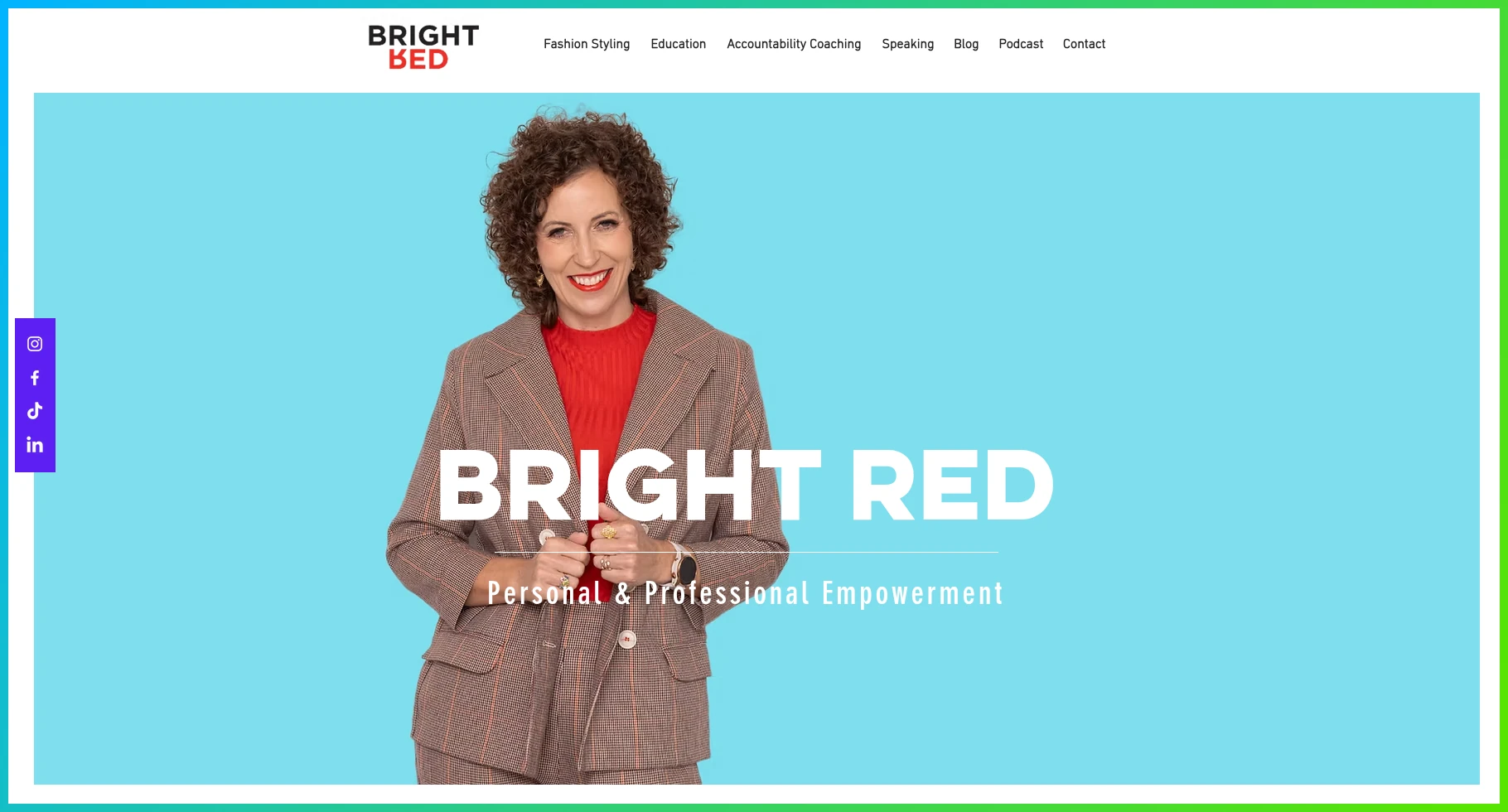
From 132 Clicks to 1,320, Plus 210 Number One Google Rankings
Bright Red is a multi-service styling and coaching business with genuine expertise across colour analysis, personal styling, workplace education, resilience training, speaking, and accountability coaching — and almost zero organic search presence when the engagement began. Ten months of structured digital marketing transformed that entirely. Stephanie Rumble’s business went from generating 132 organic clicks per month to a peak of 1,320, accumulating over 210 number one Google rankings and more than 1.1 million total impressions across the campaign. This case study documents exactly how that happened — and what it means for any creative business sitting on deep expertise that search engines cannot yet find.
This engagement is part of our Case Studies series, documenting real results across industries and business types. For everything TriOrbit Digital delivers, visit Our Work.
Monthly organic clicks grew from 132 to 1,320 in ten months — a 900% increase driven entirely by organic search.
From approximately three number one positions at campaign start to 210 — across high-volume fashion and styling search terms.
Organic search enquiries more than doubled — from 2.6 per month before the engagement to 6.1 per month after.
These results are the product of a connected system — not a single tactic. Use the links below to jump to the section most relevant to your questions.
The Challenge: How to Market a Fashion Styling Business Online
Bright Red was not a struggling business with a weak product. Stephanie Rumble had built genuine expertise across fashion styling, colour consultancy, workplace education, and personal coaching — and a growing audience that validated it. The problem was discoverability. All of that authority, credibility, and expertise was effectively invisible to anyone who had not already heard of her. A potential client searching Google for a stylist in New Zealand would not find Bright Red. The engagement was built to change that.
The core challenge was turning a highly credible but digitally invisible business into one that could be found, trusted, and contacted online. Bright Red had the expertise. It did not have the infrastructure — keyword strategy, technical foundation, or content architecture — to translate that expertise into organic search visibility. Personal styling business marketing is not about raw talent; it is about making that talent discoverable.
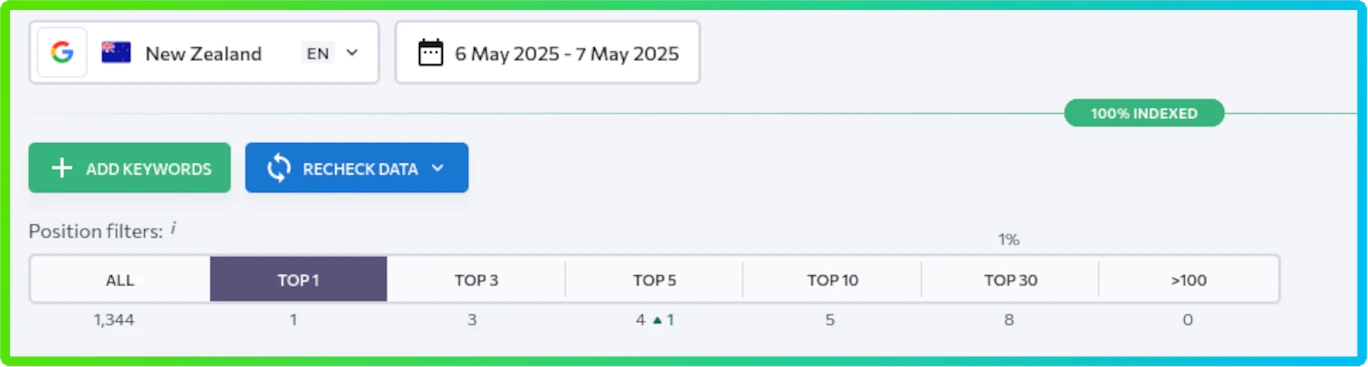
- Near-zero organic presence. At the start of the engagement in July 2025, the site was generating approximately 132 clicks and around 13,000 impressions per month — well below the threshold needed to generate consistent enquiries from search.
- A podcast library that search engines could not access. Stephanie had built an extensive library of podcast episodes documenting her expertise across fashion, colour analysis, body shape, and personal styling — content her audience valued and that demonstrated genuine authority. Converting that existing library into indexed, keyword-mapped articles was the fastest and most defensible route to topical authority available.
- No keyword strategy. The site had no systematic approach to which search terms it was targeting. Pages existed but were not built around specific audience search intent, and high-value keyword opportunities across the fashion styling niche had not been addressed.
- Technical SEO gaps. The site had technical issues suppressing visibility — incomplete metadata, structural inconsistencies, and missing signals that Google uses to assess relevance and authority.
- Minimal conversion infrastructure. Service pages were underdeveloped, calls to action were inconsistent, and there was no structured enquiry pathway to convert traffic into leads. In the two lowest months — February and March 2025 — the entire website generated a combined three organic enquiries from search.
Before TriOrbit Digital
These are not unusual problems for a creative business built around personal expertise. Translating that expertise into a fashion brand online presence that search engines can index, surface, and trust is precisely the work a structured digital marketing engagement delivers.
The Approach: Digital Marketing for Fashion Stylists
The strategy combined technical SEO foundations, content transformation, Google Business Profile management, and website conversion optimisation — structured as a connected system rather than a collection of independent tactics. Every element was built to compound: as the technical foundation strengthened, more content was indexed; as content authority grew, new ranking opportunities opened. This is what a fashion stylist marketing strategy looks like when it is built for long-term results.
The engagement ran across four structured stages — each building on the last:
- Stage 1: Foundation. Full technical audit, keyword mapping across Bright Red’s complete service offering, configuration of GA4, Google Search Console, Google Tag Manager, SE Ranking, and Rank Math, and the first batch of podcast episode conversions.
- Stage 2: Expansion. 31 service pages built across all of Bright Red’s service areas, each with enquiry forms, conversion tracking, and internal links connecting to the growing content library.
- Stage 3: Momentum. Completing the content backlog, publishing 13 additional podcast articles, establishing Google Business Profile management as a consistent monthly activity, and brand alignment refinement.
- Stage 4: Authority & Expansion. Continued podcast-to-article publishing and additional hub content to reinforce the core service-page rankings, alongside ongoing Google Business Profile management and technical monitoring as organic visibility kept compounding.
Throughout the engagement, every task was managed through a shared ClickUp workspace — giving Stephanie real-time visibility into what was being worked on, what was complete, and what was coming next. Monthly reporting was delivered as plain-English summaries tied to business outcomes, not data dumps. Monthly video check-ins kept the strategy aligned as the campaign evolved and Bright Red’s visibility grew.
SEO & Technical Foundation
Comprehensive audit, keyword mapping, metadata overhaul, and tool configuration — the infrastructure everything else was built on.
Content at Scale
90+ podcast episodes converted into keyword-mapped SEO articles — turning Stephanie’s existing expertise into indexed, searchable content.
Local Visibility & Social
Dedicated Google Business Profile management and Instagram alignment — strengthening local authority and amplifying content reach.
Website & Conversion
31 targeted service pages across Bright Red’s full offering, each with enquiry forms, CTAs, and conversion tracking — turning traffic into leads.
SEO for Fashion Stylists
The engagement began with a comprehensive technical audit. Keyword mapping across the fashion styling niche identified specific, high-intent search terms that Bright Red had the authority to rank for — and that were generating meaningful search volume. Metadata across the site was reviewed and updated: title tags, meta descriptions, heading structures, and image alt text were aligned to the keyword plan across every existing page.
Tools & Platforms
- SE Ranking: ongoing keyword tracking and rank position monitoring throughout the campaign.
- Rank Math: on-page SEO signals and metadata management within WordPress.
- Google Search Console: primary measurement for impressions, clicks, CTR, and position movement.
- Google Analytics (GA4): on-site behaviour, session data, and conversion pathways.
- Google Tag Manager: tracking implementation across forms and key conversion events.
Content Marketing for Fashion Business
The most significant content opportunity was the podcast library. Stephanie had recorded over 100 hours of audio content covering virtually every topic a fashion-conscious audience might search for. TriOrbit Digital converted more than 90 podcast episodes into fully structured, SEO-optimised articles — each mapped to a specific keyword cluster, each following a consistent publishing framework designed to build topical authority across the fashion styling niche.
What This Involved
- 90+ podcast episodes converted into keyword-mapped SEO articles.
- Each article mapped to a specific keyword cluster and search intent.
- Topics: fashion trends, colour analysis, body shape, personal styling, workplace dressing, and more.
- Consistent publishing framework applied across every article for structural authority signals.
- Internal links connecting each article to relevant service pages.
Social Media Marketing and Local Visibility for Fashion Stylists
Google Business Profile was managed as a dedicated weekly activity throughout the engagement — posts, monitoring, review management, NAP consistency, image optimisation, and category optimisation. Competitors had stronger profiles at the outset, and closing that gap was a specific objective. Consistent GBP activity contributes to local search visibility and domain trust in ways that complement the organic content strategy — particularly for a New Zealand styling business where local search queries are a primary discovery channel.
Google Business Profile — Weekly Activities
- Weekly posts published to the GBP listing.
- Review monitoring and response management.
- NAP (Name, Address, Phone) consistency across all listings.
- Image optimisation and regular media updates.
- Category and description optimisation.
Instagram alignment supported the content calendar, reinforcing key topics and directing engaged social audiences toward published articles and service pages. Fashion stylist social media growth was treated as a trust and traffic channel rather than a standalone campaign — social signals that reinforce organic foundations compound over time, whereas isolated social campaigns stop producing results the moment activity stops.
Website Optimisation and Conversion
Over the course of the engagement, 31 targeted service pages were built across Bright Red’s full service offering — each built around a specific keyword cluster, structured with clear value propositions and strong calls to action, and paired with an enquiry form and conversion tracking via Google Tag Manager. This breadth of service coverage is what accounts for much of the keyword diversity behind the 210 number one rankings — the site was not just ranking for fashion terms but for the full range of what Bright Red offers.
Service Areas Covered
- Fashion styling and personal shopping.
- Colour consultancy and colour analysis.
- Workplace education and resilience training.
- Speaking engagements and fashion hosting.
- Accountability coaching.
Testimonials were structured and positioned at key conversion points. Internal linking across the full site was reviewed and rebuilt to connect the content library to the service pages and signal topic relevance to Google. For a fashion styling business, the website is both the credibility signal and the conversion engine — and Small Business Digital Marketing of this type works precisely because every structural improvement makes the site more trustworthy to Google and more persuasive to a potential client simultaneously.
The Results: Ten Months of Compounding Growth
In ten months, Bright Red’s organic performance was transformed. Monthly clicks grew from 132 to a peak of 1,320 — a 900% increase. Monthly impressions grew from approximately 13,000 to a peak of 186,000. The site crossed the milestone of 1,000 organic clicks in a single month on 19 February 2026, then climbed to 1,320 in March and held at 1,270 in April 2026. Across the full measurement period to April 2026, Bright Red accumulated 8,170 total organic clicks and 1.17 million total impressions. These are the small business case study results that emerge when a structured system is built and maintained with consistency.
Jul 2025 → Mar 2026
Peak — Mar 2026
Up from 1 at start
2.6/month → 6.1/month from search
Peak — Feb 2026
12-month period to Apr 2026
Monthly Organic Clicks — Bright Red (Jul 2025 – Apr 2026)
Source: Google Search Console · Monthly data · Campaign start: July 2025
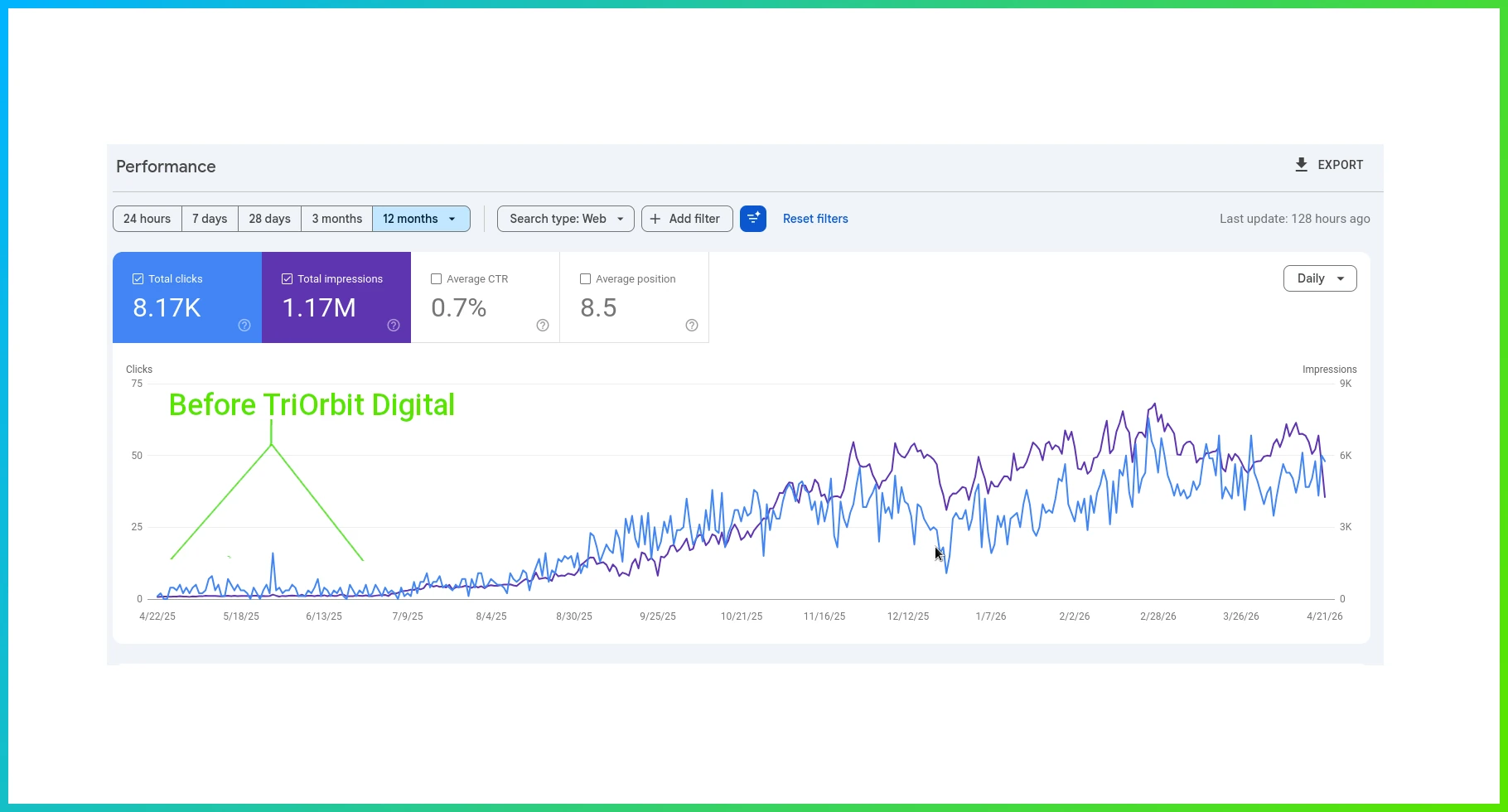
The number of keywords Bright Red now holds at number one is difficult to convey in a single statistic. By the end of April 2026, the site held the top position in Google for over 210 individual search terms — built from a near-zero starting point in under a year.
Key Number One Rankings
By the end of April 2026, Bright Red held the number one position for over 210 individual search terms — across a niche that demands genuine authority to rank in. Among the highest-volume keywords secured during the campaign:
- “fashion new zealand” — 480 monthly searches
- “body shape” — 440 monthly searches
- “fashion week” — 320 monthly searches
- “personal shopper nz” — 260 monthly searches
- “race day outfits nz” — 260 monthly searches
- “stylist” — 210 monthly searches
These rankings did not happen at once. The growth curve above reflects a deliberate, compounding process: technical foundations first, then content at volume, then authority signals — each phase creating the conditions for the next. The steep rise in clicks from August to September 2025 reflects the point at which enough content had been published and indexed for search engines to begin treating Bright Red as a recognised authority in the fashion styling niche. From that point, organic growth for fashion business became self-reinforcing: more rankings drove more traffic, which strengthened domain authority, which opened more ranking opportunities.
The scale of content output underpins all of it. Across the campaign, the Bright Red website gained more than 90 new podcast articles — episodes converted into keyword-mapped content — alongside 31 new service pages and supporting hub content covering every area of Bright Red’s service offering. For a small business, this kind of content density in a focused niche is what builds the topical authority that number one rankings require. Most businesses publish a handful of posts per year; Bright Red published more than 90 podcast articles, on top of its new service and hub pages, in under ten months.
As of April 2026, 134 individual pages on the Bright Red website are generating organic clicks — from podcast articles to service pages to the homepage. The top article alone received 884 clicks. This is what content breadth at scale looks like.

Rankings That Generated Organic Enquiries
Traffic and rankings are measures of visibility. Enquiries are the measure of commercial impact — people who found Bright Red through search and made contact. In the same ten-month window, organic search enquiries grew by 135%. But the number alone understates what changed. The nature of those enquiries shifted as fundamentally as the volume.
Before TriOrbit Digital
2.6 /month
average organic search enquiries
- One Contact form — no service-specific enquiry pathways.
- Google only — no enquiries from any other search engine.
- 3 combined organic enquiries across February and March 2025.
- 26 organic enquiries across the full 10-month period.
After TriOrbit Digital
6.1 /month
average organic search enquiries
- 7 distinct service forms — 66% of enquiries arrive through specific service pages.
- 5 search engines generating leads: Google, Bing, Yahoo, DuckDuckGo — and ChatGPT.
- Monthly floor settled at 7/month by November 2025 and held there.
- 61 organic enquiries across the same 10-month window.
The form diversification tells the deeper story. Before the engagement, every enquiry arrived through a single generic Contact form — the digital equivalent of someone knocking on the front door. After the service page build, 66% of organic enquiries came through dedicated forms for Colour Analysis, Personal Styling, Personal Shopping, Body Shape, and Stylist Training. A person completing a Colour Analysis form has already identified the specific service they want. That is a fundamentally warmer lead, and it is a direct product of building the right pages.
Organic social enquiries grew by 129% over the same period — without a dedicated social budget. As the content library expanded and was shared through Bright Red’s channels, social audiences followed content back to the site. The SEO campaign created the content; social amplified it. Both continue to compound.
Ahead in AI Search Too
Search is changing. AI Overviews in Google, AI-generated answers in ChatGPT, and the growing use of AI assistants for research and product discovery mean that appearing in AI-generated responses is becoming as important as ranking on the first page. The businesses that get cited in AI answers are the same ones that rank well organically — because both systems reward the same thing: genuine expertise, published at depth, on a technically sound website. Bright Red’s content-led strategy built both simultaneously.
Across the New Zealand fashion styling market, Bright Red now sits alone at the front of the competitive landscape for AI search. With an AI presence score of 0.32% — multiple times higher than any tracked competitor — Bright Red is the business that AI systems are drawing on when answering fashion, styling, and colour-related queries. Most competitors register near zero. This is not a gap that closes quickly. Topical authority of this scale, built on more than 90 pieces of keyword-mapped expert content, is a durable advantage in both traditional and AI-driven search.
This is not a theoretical metric. In January 2026, Bright Red received a verified commercial enquiry via ChatGPT — a real person asking an AI assistant about stylist training in New Zealand, and being directed to Bright Red’s website. AI search presence, in this case, produced a real lead.

Hear It From Stephanie
Numbers tell part of the story. Stephanie Rumble tells the rest. In this short interview, she shares what the business looked like before the engagement, how the process felt from her side, and what the growth has meant for Bright Red’s day-to-day.
“I am proud to say that I have been working with Leonard and Vanna from TriOrbit Digital for the past six months. They are a very talented team who have provided me with exceptional service and ongoing support to get my website and search engines ranking more highly over this time. They have transformed the way everything looks and are beyond thorough with a very strong eye for detail. They have gone out of their way to research all of the work they do for me so that everything ranks more highly and ultimately translates into greater sales. I am excited about the plans we have made together for 2026 and am looking forward to working with them more closely with them both. I highly recommend them both.”

Stephanie Rumble
Founder, Bright Red
Ready to Build Results Like This for Your Business?
The results Bright Red achieved are the product of a structured, systematic approach — not luck or shortcuts. If you are ready to build a digital marketing system that compounds over time, the right place to start is a free strategy call. Thirty minutes. No sales pressure. A clear picture of where you stand and what the path forward looks like.
Frequently Asked Questions
Questions about how TriOrbit Digital approached the Bright Red campaign — and what this fashion stylist case study demonstrates about structured digital marketing for small and creative businesses.
What digital marketing services did TriOrbit Digital provide for Bright Red?
TriOrbit Digital delivered a structured, multi-stage digital marketing engagement built across four phases. Stage 1 established technical foundations — a full site audit, keyword mapping, and configuration of Google Analytics, Google Search Console, Google Tag Manager, SE Ranking, and Rank Math. Stage 2 expanded the site’s content architecture with 31 new service pages across Bright Red’s full service offering, each with enquiry forms and conversion tracking. Stage 3 focused on momentum, brand alignment, and consistent Google Business Profile management. Stage 4 (March–April 2026) continued content publishing and hub articles to reinforce the core service-page rankings. Podcast episodes were converted into fully keyword-mapped, SEO-optimised articles throughout, and all activity was tracked through Google Search Console and Google Analytics, with monthly reporting delivered as plain-English summaries via a shared ClickUp workspace.
What challenges was the fashion styling business facing before working with TriOrbit Digital?
Bright Red was generating approximately 132 organic clicks and around 13,000 impressions per month when the engagement began in July 2025 — well below the level needed to generate consistent enquiries from search. The site had no structured keyword strategy, significant technical SEO gaps, and a large library of podcast content that was not accessible to search engines. Service pages were underdeveloped, calls to action were inconsistent, and there was no clear conversion pathway for visitors who found the site.
How long did it take to achieve measurable results for the fashion stylist client?
Measurable movement began within the first two months. Monthly clicks doubled from 132 in July 2025 to 278 in August 2025 as technical improvements and initial content publications began to take effect. The most significant step-change occurred between August and September 2025, when clicks jumped to 730 per month — reflecting the cumulative effect of content volume reaching a critical mass in search indexes. Growth continued steadily from that point, reaching 1,100 monthly clicks by February 2026 — the first time the site crossed 1,000 clicks in a single month — and peaking at 1,320 monthly clicks in March 2026.
What SEO strategies were used to increase organic visibility for the fashion styling business?
The SEO strategy had three core components. First, a technical foundation phase: a full site audit using Google Search Console data, keyword mapping across the fashion styling niche, and systematic metadata updates across all existing pages. Second, a topical authority phase: more than 90 podcast episodes were converted into keyword-optimised articles, each mapped to a specific search intent cluster, building the site’s recognised expertise across fashion, colour analysis, body shape, and personal styling topics. Third, an ongoing refinement phase: internal linking, rank monitoring through SE Ranking, and regular reporting against Google Analytics benchmarks.
How did social media marketing contribute to Bright Red’s online growth?
Social media marketing for fashion stylists played a supporting role in the overall strategy. Instagram activity was aligned with the content calendar so published articles were amplified to Bright Red’s existing following, generating referral signals and brand awareness that reinforced the SEO work. Google Business Profile management was handled throughout the engagement — regular updates, category and description optimisation, and review management — contributing to local authority signals that strengthen overall domain trust. Fashion stylist social media growth was treated as a compounding trust channel, not a standalone campaign.
What metrics were used to measure the success of the digital marketing campaign?
Google Search Console provided the primary performance data: total clicks, total impressions, average click-through rate, and average position across all indexed pages. Google Analytics tracked on-site behaviour — sessions, engagement rate, and conversion pathways. SE Ranking monitored specific keyword positions week by week, allowing the strategy to respond to ranking movements as they occurred. Rank Math provided on-page SEO scoring within WordPress. Monthly reporting was structured around these data sources, with results compared against the July 2025 baseline at each reporting period.
Can other fashion stylists expect similar results from a structured digital marketing approach?
The results Bright Red achieved reflect three factors: a genuine, established expertise that search engines could validate; a willingness to publish content at volume and consistently over time; and a structured technical foundation that gave new content the best possible chance of being discovered and ranked. Fashion stylists with similar authority and a commitment to content transformation can achieve comparable outcomes, though timelines and specific metrics will vary based on existing domain authority, keyword competition, and content velocity. A strategy call is the best way to understand what realistic outcomes look like for a specific business.
What role did content creation play in the fashion stylist’s digital marketing strategy?
Content was the primary growth driver. Converting more than 90 podcast episodes into fully structured, SEO-optimised articles gave Bright Red a large volume of topically authoritative content in a short timeframe. Each article was mapped to a specific keyword cluster, included appropriate internal links, and was structured to target the question-based and topic-based searches that fashion-conscious audiences use in Google. Content strategy for fashion stylists of this type — transforming existing expertise into searchable formats — is typically the highest-leverage opportunity available for businesses with established authority but limited online visibility.
How does TriOrbit Digital’s approach differ from a generic digital marketing agency?
The core difference is systems thinking versus tactic thinking. Most agencies operate on retainer deliverables — a set number of posts, articles, or hours per month — without a clear model for how those activities compound into long-term authority. TriOrbit Digital structures every engagement as a connected system: technical foundations support content indexing, content volume builds topical authority, authority expands ranking opportunities, and expanded rankings drive compounding traffic growth. Every decision in the Bright Red engagement was made in the context of the whole system — not as an isolated task. The result is organic growth that continues building after the campaign rather than stopping when activity stops.
What does this fashion stylist case study demonstrate about long-term digital marketing?
The Bright Red case study demonstrates three things. First, that expertise alone does not generate online visibility — it must be structured, published, and technically supported before search engines can surface it. Second, that organic growth is genuinely compounding: the steep click growth from August to September 2025 was the result of months of preparatory work, not a sudden tactic change. Third, that the long-term value of organic rankings far exceeds short-term paid alternatives — Bright Red’s 210 number one rankings continue generating traffic without ongoing spend. This is what creative business digital marketing looks like when it is built as a system rather than a campaign.
How was the client’s website optimised to support the overall digital strategy?
Website optimisation covered four areas. Technical SEO: metadata, heading structure, page speed, and crawlability were addressed in the initial audit phase, providing a clean foundation for new content to be indexed effectively. Service pages: 31 new pages were built, each describing a specific Bright Red offering with clear value propositions and conversion-focused copy. Conversion infrastructure: enquiry forms were implemented and tested, CTAs were added at key decision points, and testimonials were structured to build trust at critical pages. Internal linking: the full site was reviewed and a systematic internal linking structure was built to connect the content library to the service pages and to signal topic relevance to Google.
What would a comprehensive digital marketing strategy for a fashion stylist business typically include?
A comprehensive strategy typically covers six areas: technical SEO foundations covering metadata, page speed, structure, and crawlability; keyword research mapped to specific fashion niche audience intent; content production at volume, transforming existing expertise into searchable, indexed articles; Google Business Profile management to strengthen local and topical authority; social media alignment to extend content reach and build referral traffic; and conversion optimisation covering service pages, CTAs, and enquiry pathways. For personal styling business marketing, the content and SEO components typically deliver the highest return in the shortest timeframe — particularly when a business already has deep, demonstrable expertise in its niche.