

The right time to hire a digital marketing agency is when your in-house marketing is producing inconsistent results, your team is stretched beyond capacity, or your competitors are gaining online ground that you are not closing. If time and budget are going into marketing without measurable returns, bringing in specialist support is a more structured and scalable path forward.
Key Takeaways
- The right time to hire is sooner than most business owners act — businesses that build digital foundations while things are still going reasonably well compound their advantage far faster than those who wait for results to deteriorate.
- A full-service agency’s value comes from integration — SEO data feeds content, content drives organic traffic, paid campaigns retarget visitors who did not convert, and each channel compounds the others over time.
- A single agency retainer can cover SEO, content, paid media, and social at a combined cost less than employing one senior specialist in any of those disciplines individually.
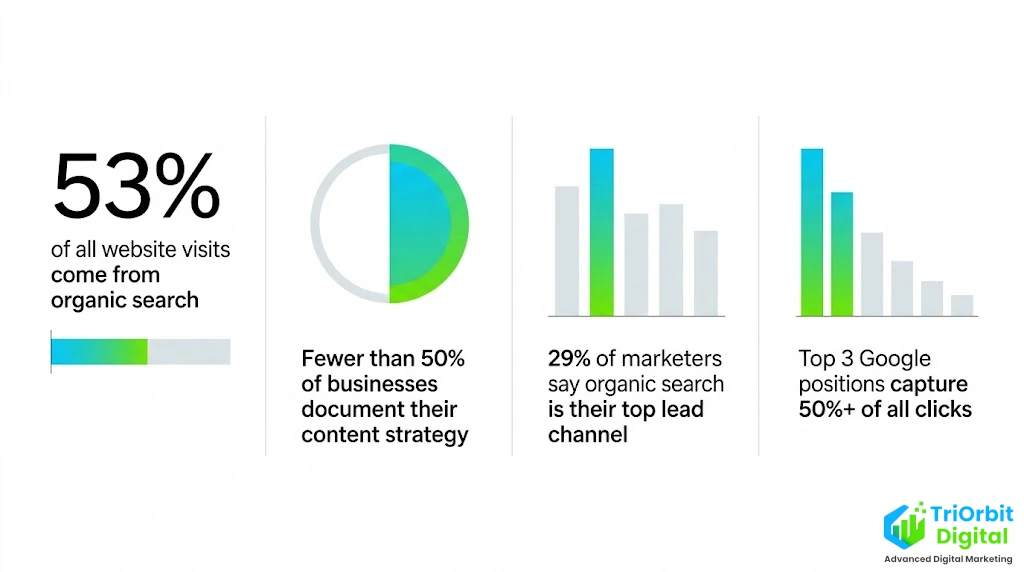
- Organic search drives 53% of all trackable website visits, and the top three positions capture more than half of all clicks — every month without a structured SEO strategy is a month of compounding loss.
- When your analytics are no longer driving decisions — you can see the data but not what to do with it — that is one of the clearest signals that specialist support is needed.
Most business owners reach a point where managing their own marketing stops being enough. The early-stage approach — a social post here, a boosted ad there, a newsletter when time allows — served its purpose. But as the business grows, the gap between what ad hoc marketing delivers and what professional, structured execution can achieve widens considerably. Digital marketing has matured into a discipline that demands consistent strategy, deep platform knowledge, and regular execution across multiple channels simultaneously.
When to hire a marketing agency is not a question with a single universal answer. It depends on your stage of growth, the competitive landscape in your category, and how much ground you have already ceded to businesses that started building their digital foundations earlier. What is consistent across almost every case is that the right time is sooner than most business owners act on it.
This article works through the clearest signals that the time has come — what agencies do, whether they deliver genuine return, what they cost, and how to find the right fit. The goal is a clear, honest framework, not a push in any direction.
What Does a Digital Marketing Agency Do?
A digital marketing agency plans, executes, and manages the activities that build a business’s visibility online and convert that presence into leads and revenue. A full-service engagement typically covers:
- SEO strategy and keyword research.
- Content creation and publishing.
- Paid advertising management.
- Social media management.
- Analytics tracking and performance reporting.
The scope varies depending on the agency’s model. Some specialise in one or two disciplines — paid media, or SEO, or social. Full-service agencies manage the entire digital ecosystem as a cohesive system, where each channel informs and supports the others. The distinction matters when you are deciding which type of support fits your situation.
A specialist paid media agency might focus purely on Google Ads or Meta Ads Manager campaigns. A full-service digital marketing agency builds an integrated strategy across organic search, paid traffic, content, email, and social. Each channel reinforces the others. Your SEO keyword data feeds your content programme. Your content drives organic traffic. Your paid campaigns retarget visitors who did not convert the first time. That compounding effect is one of the most significant advantages a well-run agency engagement produces.
Beyond execution, a good agency provides strategic oversight. That means identifying:
- where your greatest growth opportunities are.
- where competitors are outperforming you.
- where your current marketing is losing leads.
That layer — looking at the whole picture rather than a single channel — is often the hardest element to replicate in-house.
TriOrbit Digital
Is Your Digital Marketing Working as Hard as Your Business?
You’ve identified the signs — now get a clear picture of where your marketing actually stands. At TriOrbit Digital, we break down your current digital presence, identify the gaps, and map a structured path forward. No confusing tech talk, no log-in contract.
Clear Signs It Is Time to Hire a Digital Marketing Agency
The decision to bring in an agency rarely arrives as a single moment of clarity. More often, a pattern of frustrations accumulates until the cost of staying the course becomes more apparent than the cost of change. The signals below are the most consistent indicators that professional support is the right next step.
Your In-House Expertise Has Reached Its Limits
Every business eventually reaches the boundary of what its team knows how to do well. Digital marketing is a field where expertise makes an enormous practical difference — the gap between a poorly structured Google Ads campaign and a well-optimised one can mean the difference between burning through a budget and producing a measurable return. The same is true across every core discipline:
- Technical SEO.
- Content strategy and production.
- Conversion optimisation.
- Analytics and performance reporting.
Limited skills within the team are not a failure. It is a predictable consequence of growth. A marketing capability built for the business at one stage will eventually be underprepared for the demands of the next. When those gaps fall in disciplines where mistakes are expensive and learning curves are steep, filling them with specialists is usually more cost-effective than upskilling in-house. It also produces results considerably faster.
Inconsistent branding is frequently a symptom of the same problem. When different team members manage different channels without a unifying strategy or clear guidelines, the business’s voice and visual identity fragments across platforms. An agency imposes a structure that prevents this — consistent messaging, consistent tone, and consistent positioning across every touchpoint.
The rapid pace of change in digital marketing compounds the skills gap further. Algorithm updates, new platform features, and the growing role of AI in search and advertising require continuous learning. Publications like Search Engine Land document these changes in real time — agencies consume and act on that information as a core part of their operation. In-house teams managing other responsibilities alongside marketing rarely have the bandwidth to keep pace.
You Are Consistently Falling Behind Competitors Online
If competitors who were once at your level are now:
- Outranking you in search results.
- Running more visible advertising.
- Dominating the platforms where your audience spends time.
…that gap will not close on its own. Without deliberate action, it widens. Organic search rankings compound in both directions — the businesses that build and maintain them grow harder to displace; those that neglect them fall further behind.
Falling behind competitors in online visibility is not simply a matter of ego. It directly affects which businesses prospective customers consider and which they overlook. According to Think with Google, organic search accounts for 53% of all trackable website visits — making it the largest single driver of online traffic for most businesses, and the one most directly shaped by long-term, consistent investment. By the time someone runs a search, they are already pre-qualified — they know they want what you offer. The question is whether they find you or someone else.
Producing Consistent, Quality Content Has Become a Struggle
Content is the engine of organic growth. Building topical authority requires consistent output across a wide range of formats:
- Blog articles and SEO-optimised landing pages.
- Case studies and authority content.
- Video scripts and social posts.
The volume and quality required to sustain visibility is significant. For most in-house teams managing content alongside other responsibilities, the output becomes either inconsistent or thin.
Struggling to produce consistent, quality content is one of the most common reasons businesses seek agency support — and one of the most underestimated costs of DIY marketing. According to the Content Marketing Institute‘s annual B2B benchmark research, fewer than half of B2B organisations maintain a fully documented content strategy — meaning most are managing their content marketing reactively rather than from a structured plan. The problem is rarely a lack of effort. It is structural. Keyword research, content strategy, production, editing, publishing, and performance analysis form a workflow that requires dedicated content writing services. Without this structure, content is produced ad hoc, gaps are left unfilled, and the compounding SEO value of a steady publishing programme is never realised.
Lack of fresh, creative ideas is a related symptom. Teams that have been running the same channels for a long time naturally exhaust their initial creative reserves. An agency brings an outside perspective — new angles, new formats, and a creative process that generates ideas independent of the internal familiarity that tends to limit in-house thinking.
Your Analytics Are Not Driving Decisions
Most growing businesses have access to more data than they know what to do with:
- Google Analytics 4.
- Search Console.
- Ad platform dashboards.
- Social media analytics.
The challenge is not collection. It is interpretation. Knowing what to look for — and acting on it quickly enough to matter — requires analytical expertise that most general marketing teams do not carry.
When analytics are not translating to actionable insights, you are operating without feedback. You can see that organic traffic dropped but cannot diagnose why. Your ads are running but you cannot tell whether they are profitable. An agency turns those numbers into decisions: what to fix, what to scale, and where the next opportunity is most likely to appear. Dedicated Google Analytics services ensure the tracking architecture is in place to make that analysis possible. HubSpot, Google Analytics 4, and the major ad platforms all produce significant data. The value comes from interpreting it correctly, not from having access to it.
Your Marketing Workload Has Outgrown Your Team
Sometimes a growing business has a marketing team that is simply at capacity. Sometimes the business owner is still the entire marketing team. Both are signs that the current structure is unsustainable. Managing a modern digital marketing operation is a full-time job. The routine tasks alone include:
- Content planning and calendar management.
- Keyword tracking and SEO reporting.
- Paid account management and optimisation.
- Social media scheduling and monitoring.
- Cross-channel performance reporting.
That is before accounting for the strategic work that needs to sit above it.
An unmanageable workload for a marketing team does not only affect output quality. It affects judgement. Overextended marketers make reactive decisions, deprioritise strategy for execution, and eventually produce the kind of inconsistent, unfocused marketing that fails to build towards anything. Bringing in agency support either takes the load off entirely or fills the specialist gaps that allow an existing team to operate at its actual capability.
Expanding a business without a scalable marketing strategy is a closely related problem. If growth is being driven by increasing ad spend without a supporting organic foundation, or by producing more content without a clear keyword architecture, the returns will plateau. An agency builds the foundation that scales efficiently. The structure it creates continues to produce results as the business grows, rather than demanding proportionally more investment for diminishing returns.
You Need to Focus on Running Your Business
For business owners still involved in day-to-day marketing — writing social posts, managing ad accounts, reviewing analytics — the opportunity cost is significant. Every hour spent on marketing is an hour not available for:
- Product development.
- Client relationships.
- Team leadership.
- Strategic decisions that only the business owner can make.
Needing dedicated focus on core business operations is ultimately the simplest case for bringing in an agency. If your marketing is consuming your time and still producing inconsistent results, spending more of your own time on it is not the solution. It means putting it in the hands of specialists who do this work every day, and redirecting your attention to the work only you can do. The first step is to book a free strategy call and find out what a structured approach would look like for your specific situation.

The Benefits of Hiring a Digital Marketing Agency
Bringing in an agency does not simply offload work — it changes what is possible. Benefits of hiring a digital marketing agency extend well beyond the hours recovered. They include access to specialist expertise and professional tools that most businesses cannot economically sustain in-house, and a strategic structure that produces compounding results over time.
The most significant benefits businesses consistently experience:
- Specialist expertise across multiple disciplines: SEO, paid media, content, analytics, social, and automation — without the cost and overhead of hiring each as a full-time employee.
- Access to professional-grade tools: — platforms such as LowFruits for keyword research, Google Analytics 4 for performance tracking, and paid advertising platforms operated by specialists with the experience to use them effectively.
- Strategic oversight: a team focused on the full digital ecosystem rather than isolated channels, identifying how each component supports the others
- Consistent execution: campaigns and content delivered on schedule, without the gaps created by competing internal priorities.
- Adaptability to change: agencies track algorithm updates, platform changes, and the evolving role of AI marketing as a core part of their work, adjusting strategy before the impact reaches your results.
- An external perspective: fresh thinking on creative direction and campaign strategy, independent of the internal assumptions that tend to accumulate in long-running in-house programmes.
The businesses that gain most from agency partnerships are typically those that approach them as long-term engagements rather than short-term projects. Digital marketing results compound. The early-stage SEO and content work done in the first few months pays dividends in organic rankings, content authority, and brand visibility for months afterwards. An engagement treated as a three-month trial rarely has time to produce what it is capable of producing.
Understanding why hiring a digital marketing agency tends to outperform a comparable in-house investment comes down to structural economics. An agency’s cost is shared across its entire team and toolset. The per-skill cost of accessing specialist expertise through an agency is lower than the equivalent in-house hire — particularly when multiple disciplines are required at once.

Are Digital Marketing Agencies Worth It?
The honest answer depends on three things:
- The agency’s capability.
- The clarity of the brief.
- Whether the expectations are realistic.
For businesses at the right stage of growth, with a clear strategy informing the engagement, the answer is consistently yes — but the return is not automatic.
The ROI case for agencies is built on a few structural facts. Agencies carry lower per-skill costs than full-time hires. In many cases, a single agency engagement can cover SEO, content, paid media, and social at a combined cost less than employing one senior specialist in any one of those disciplines directly. The management overhead of coordinating multiple contractors or building a full in-house team is replaced by a single accountable relationship. According to HubSpot‘s State of Marketing 2025, organic search ranks among the highest-ROI inbound channels — with 29% of marketers naming it as the top lead-generating channel for their business.
The ROI challenges with DIY marketing efforts are real and consistently underappreciated. The time cost of business owners managing their own marketing rarely appears on a spreadsheet. The compounding cost of poorly structured campaigns is invisible until results fail to materialise:
- SEO without a technical foundation.
- Ad accounts without proper conversion tracking.
- Content produced without a keyword architecture.
Agency expertise prevents these inefficiencies from accumulating.
| DIY / In-House | Digital Marketing Agency | |
|---|---|---|
| Expertise | Generalist across all channels | Specialist per discipline |
| Cost structure | Fixed salaries plus tool subscriptions | Single retainer or project fee |
| Scalability | Requires new hires to grow capacity | Scope adjusted to the brief |
| Platform knowledge | Maintained alongside other work | Core daily focus |
| Speed to results | Slower — internal learning curve | Faster — existing systems and experience |
| Reporting | Self-managed, often inconsistent | Structured and accountable |
How much do digital marketing agencies make is a question sometimes used as a proxy for evaluating whether the fees are justified. It is the wrong question. The right question is whether the agency’s work generates a return that exceeds its cost. That depends on clear goal-setting at the outset — knowing which metrics matter, what baseline the business is starting from, and what timeframe is realistic. An agency that cannot answer those questions clearly at the proposal stage is unlikely to answer them clearly in reporting either.
For smaller businesses specifically, the concern is often whether the investment is appropriate at their scale. The answer is that scope can be adjusted. A business that is not yet at the scale to justify a full-service retainer can start focused — a keyword strategy and content programme, or a single paid channel managed to profitability — and expand as results justify it. The key is that the work is done correctly from the outset, even if the initial scope is narrow.
Understanding the Cost of Hiring a Digital Marketing Agency
The cost of hiring a digital marketing agency varies considerably depending on the scope of work, the agency’s model, and the channels being managed. There is no universal pricing — but understanding the common structures helps set realistic expectations before entering any conversation.
Most agencies price in one of three ways:
- Monthly retainer: a fixed fee for an agreed scope of ongoing work. The most common model for long-term partnerships. Retainers range broadly depending on scope and the number of channels managed.
- Project-based pricing: a fixed fee for a defined deliverable: a website build, an SEO audit, a content programme with a set number of pieces. Better suited to discrete work with a clear endpoint.
- Performance-based or hybrid pricing: a base fee combined with a variable component tied to results. Less common, but available through some agencies for paid media management.
Digital marketing agency cost at the entry level — for a focused scope such as local SEO or social media management — can be accessible even for businesses early in their growth. A full-service engagement managing multiple channels — SEO, content, paid advertising, and social — is a more substantial investment. It is appropriate for businesses that have the revenue to support it and the growth ambition to justify it.
How much does it cost to hire a marketing agency is a question best answered through a strategy conversation rather than a rate card. What a business needs — and therefore what it should pay — depends on its current digital baseline, its competitive environment, and its growth goals. Agencies that publish flat rates without understanding the brief are unlikely to scope the work correctly.
Budget considerations should also account for the fact that agency fees typically cover management and strategy — not media spend. If the brief involves running paid advertising, the ad spend is a separate budget item on top of the management fee. This distinction matters significantly when comparing proposals.
How much does it cost to hire a social media marketing agency specifically? Dedicated social media management tends to sit at a lower price point than full-service digital marketing, making it a common entry point for businesses exploring an agency relationship for the first time before expanding the scope.
How to Choose a Digital Marketing Agency That’s Right for You
Choosing the right agency matters more than simply choosing any agency. A misaligned engagement — wrong specialist for the brief, incompatible working styles, unclear expectations on both sides — produces poor results and erodes confidence in digital marketing as a whole. The selection process deserves as much attention as the decision to hire.
How to choose a digital marketing agency comes down to a focused set of criteria:
- Relevant experience: has the agency worked with businesses at your stage of growth or in your category? Can they demonstrate what they have achieved in situations comparable to yours?
- Transparent process: can they explain clearly what they will do, how they will measure it, and what success looks like? Vague promises and jargon-heavy pitches are a consistent warning sign.
- Realistic expectations: any agency that guarantees fast rankings, instant ROI, or specific traffic numbers within a short timeframe should be approached with caution. Legitimate digital marketing results take time to compound.
- Clear communication model: how will they report? How often? Who is the direct point of contact? An agency that is difficult to reach or slow to report is difficult to manage and course-correct.
- Cultural fit: you will be working with these people on an ongoing basis. Their working style and approach to communication should align with how your business operates.
These criteria narrow the field considerably. Once you have a shortlist, the following questions test the substance behind the pitch.
Questions to ask before hiring a digital marketing agency that cut to what actually matters:
- What does success look like for this brief, and how will you measure it?
- Who specifically will be working on the account day to day?
- How do you approach reporting, and what metrics will be tracked?
- What does onboarding look like, and how long before we see early indicators of progress?
- Can you share examples of work on a comparable brief?
The answers to these questions reveal as much about how an agency operates as anything in their proposal.
Which is the best digital marketing agency is a question only you can answer — because the best agency for your business depends on your goals, your industry, your budget, and your working style. No single agency is right for every brief. The right one is the agency that understands your specific situation and can demonstrate a track record in addressing it.
The Risk of Waiting Too Long to Bring in Agency Support
There is a cost to delay that most business owners underestimate until they are on the wrong side of it. Every month without a structured digital marketing strategy is a month of lost ground. While you wait, competitors are:
- building the search rankings you will later need to displace.
- producing the content that will outrank yours.
- warming the audiences you have not yet reached.
SEO is the clearest example of compounding loss. Organic rankings build slowly and accumulate over time. Analysis published by Search Engine Land shows that the top three positions on Google capture more than half of all clicks for a given query — with each subsequent position receiving sharply diminishing returns. A business that starts building its keyword foundation today will be significantly better positioned in twelve months than one that waited. Deferring the decision to hire an agency is not a neutral choice. It is a decision to start the compounding clock later, with a larger gap to close.
Searches for a digital marketing agency near me or equivalent reflect a common pattern: business owners act when growth has already stalled or a competitive threat has become impossible to ignore. By that point, the work required to recover the lost ground is considerably greater than the work required to have built the foundation earlier. Starting from a position of strength — before the gap has opened — is always the more efficient use of the investment.
Building the Foundation Before You Fall Behind
The question of when to hire a digital marketing agency ultimately comes down to a simpler one: is your current marketing building something durable, or is it filling time until the next algorithm change or platform shift disrupts it? Structured, compounding digital growth does not happen by accident. It is the result of a clear strategy, consistent execution, and the specialist knowledge to adapt as the landscape changes.
The businesses that consistently outperform in digital marketing are not necessarily those with the largest budgets. They are the ones that built the right foundations at the right time — SEO structure that compounds, content that builds topical authority, analytics that drive real decisions — and maintained them. Waiting until you are visibly behind to begin that build makes the job harder and the timeline longer. Starting from a position of strength — while there is still ground to gain rather than ground to recover — is always the more efficient investment.
If this article has brought you to the point of taking the next step, the most productive move is a direct conversation about your specific situation. A free strategy call with a specialist takes the guesswork out of where to start — you get a clear picture of where your digital marketing stands, what the gaps are, and what a structured approach to addressing them looks like.
Frequently Asked Questions
How do I know it’s the right time to hire a digital marketing agency?
The clearest signal is a growing gap between where your business should be online and where it actually is. If your marketing results are inconsistent, your team is stretched, competitors are pulling ahead in search or social visibility, or content output cannot keep pace with what your strategy requires — those are all signs the current approach has reached its limit.
There is no universal milestone that makes the decision obvious. But the businesses that fare best are those that hire agencies while things are still going reasonably well, rather than waiting until results have clearly deteriorated. Starting from a stronger position means the foundation work compounds earlier and closes the competitive gap faster.
What is the difference between a specialist and a full-service digital marketing agency?
A specialist agency focuses on one or two disciplines — paid media, SEO, social, or content. They go deep in their area and suit situations where you have a specific, contained need, such as managing Google Ads campaigns or handling a single social channel.
A full-service agency manages multiple disciplines simultaneously as an integrated strategy. Your SEO keyword data informs your content. Your content drives organic traffic. Your paid campaigns retarget visitors who did not convert on first arrival. This compounding effect is the core advantage of a full-service engagement — each channel reinforces the others over time. The right choice depends on the breadth of your gaps and the scope of work required.
How long does it take to see results from a digital marketing agency?
Paid advertising campaigns can show results within days. SEO and content strategy take considerably longer — typically three to six months before meaningful ranking improvements emerge, and nine to twelve months before the compounding effect of a consistent publishing programme becomes visible in organic traffic growth.
This is why a realistic timeline conversation at the outset matters. An agency that cannot tell you when to expect early indicators versus sustained results will not manage expectations well in reporting either. An SEO Starter Package at the beginning of an engagement builds the technical foundation and tracking architecture before production begins — which shortens the time before content starts delivering returns.
How much does it typically cost to hire a digital marketing agency?
Costs vary considerably depending on scope, the channels being managed, and the agency’s pricing model. Entry-level engagements focused on a single channel — local SEO or basic social media management — can suit smaller budgets. Full-service retainers covering SEO, content, paid advertising, and social represent a more substantial investment, suited to businesses with the revenue to support it and the growth ambition to justify it.
Agency fees typically cover management and strategy — not media spend. If the brief includes paid advertising, the ad budget is a separate item. The most reliable way to understand what an engagement would cost for your specific situation is a direct conversation about your needs, not a rate card.
Can small businesses benefit from hiring a digital marketing agency?
Yes — and scope is the key. A small business does not need to commission a full-service retainer to see meaningful value. A focused engagement — a keyword strategy and content programme, a Google Ads setup, or a social media management brief — can deliver measurable results at a cost appropriate for smaller budgets.
The advantage is access to specialist expertise that would otherwise require multiple hires. Rather than attempting to run SEO, content, and paid media with limited in-house capability, a targeted agency relationship concentrates resource where it produces the most immediate return. Small business digital marketing services are specifically designed around this — focused scope, structured delivery, measurable outcomes.
What should I look for when choosing a digital marketing agency?
Relevant experience is the most important criterion — specifically, work with businesses at a comparable stage or in a similar category. An agency’s track record in situations like yours is more useful than general credentials or impressive client names. Ask to see examples of work and what results they produced in contexts similar to your own.
Beyond capability, look for transparency in process and communication. An agency that explains clearly what they will do, how they will measure it, and what a realistic timeline looks like is far more trustworthy than one that leads with promises. Cultural fit matters as well — you will be working with these people consistently, and a misaligned relationship produces poor results regardless of technical capability.
How does a digital marketing agency help with SEO and organic search?
An agency builds the technical foundation and content architecture that organic search rankings require. This starts with keyword research to identify the most valuable opportunities, moves through technical SEO work to ensure the site is fast and correctly structured, and extends into a content programme that builds topical authority over time.
The compounding nature of organic search makes consistency critical. A single well-optimised article helps. Fifty well-optimised articles covering the full keyword landscape of a topic produces an entirely different result. Agencies bring the team, the systems, and the sustained execution that most in-house operations cannot maintain independently alongside other business priorities.
Is it better to hire a digital marketing agency or build an in-house team?
Both approaches work — the right choice depends on scale, budget, and the breadth of disciplines required. Building in-house makes sense when marketing volume justifies dedicated headcount, when deep brand knowledge needs to live internally, or when strategy is stable enough that agency flexibility is not required.
Hiring an agency makes sense when multiple disciplines need to be covered simultaneously, when upskilling in-house would take too long, or when marketing needs are project-based or seasonal rather than constant. Many businesses run a hybrid model — a small internal team managing brand and strategy, with an agency handling execution in specialist areas. The comparison table in the article body outlines the practical differences between the two approaches.
How do digital marketing agencies measure the success of their work?
A well-run agency tracks metrics that map directly to business goals — not vanity metrics that look impressive in reports but do not translate to revenue. For SEO engagements, that means keyword ranking improvements, organic traffic growth, and conversion rates from organic sessions. For paid media, it means cost per acquisition, return on ad spend, and conversion volume.
The best measure of performance is progress toward the goals agreed at the start of the engagement. If those goals were not defined clearly at the outset, tracking meaningful progress becomes difficult. This is why the initial scoping conversation matters as much as the ongoing execution — what gets measured must be agreed before the work begins.
What are the risks of waiting too long to hire a digital marketing agency?
The primary risk is compounding loss. Every month without a structured SEO and content strategy is a month in which competitors are building the rankings you will later need to displace. Organic search results accumulate over time — starting later means beginning from a larger deficit, with more ground to close before results appear.
There is also an opportunity cost. Businesses that build their digital foundations early benefit from compounding organic traffic that grows month over month. Those that delay often compensate with paid advertising spend, which stops the moment the budget stops. If the question of timing has been on your mind, the most efficient next step is to book a free strategy call — it takes the guesswork out of where to start.