


The right digital marketing agency builds a compounding growth system for your business — not a series of campaigns that reset the moment their budget runs out. Most agencies sound exactly alike in a pitch; the difference always shows in how they think, what they report on, and whether their approach is built around your goals or their own service menu.
Key Takeaways
- An agency worth hiring asks about your goals before presenting solutions — any agency that opens with a service package is leading with its own revenue, not your outcomes.
- The pitch is not reliable evidence of capability — verify through Clutch reviews, case studies with real before-and-after data, and how the agency markets itself online.
- Ask who specifically will manage your account day to day — the people in the pitch room are usually not the ones doing the work once the contract is signed.
- An integrated strategy compounds — every channel reinforcing the others produces results that grow over time, while isolated tactics reset the moment each one stops.
- Organic search consistently delivers the best conversion results of any digital channel — AI-driven referral traffic still accounts for less than 1% of all website visits, making organic visibility the most durable asset an agency can build.
Businesses rarely need convincing about why they should choose a digital marketing agency — the difficulty is rarely deciding to hire one. It is knowing which agency to trust. Most agencies make similar claims, present polished proposals, and sound convincing in a pitch. The difference between a strong choice and a costly one rarely surfaces until after the contract is signed.
Why choose digital marketing as your primary growth lever at all? Unlike paid advertising, which stops producing results the moment the budget runs out, organic digital marketing compounds. Rankings improve. Content accumulates. Brand authority builds. An agency that genuinely understands this distinction approaches the engagement differently — they are building something durable, not running campaigns to fill a reporting quota.
When businesses weigh up why they should choose a marketing agency over handling digital marketing in-house, it usually comes down to three things:
- Depth of expertise: specialist knowledge built across many clients and industries, which is very different from generalised marketing knowledge applied to one.
- Access to a full-service team: multiple disciplines handled by people with genuine depth in each area, coordinated around a single strategy rather than siloed or handed off to whoever is available.
- Time: digital marketing done properly is not a part-time task, and most growing businesses cannot absorb the hours required without sacrificing other priorities.
Most growing businesses cannot reliably provide all three without a significant internal investment. And even then, they often lack the breadth a specialist agency brings from working across many clients and industries.
First: What Does ‘The Right’ Digital Marketing Agency Do?
Before you can choose the right agency, you need a clear picture of what you are actually buying. The scope of what a digital marketing agency does varies significantly across the industry — and the mismatch between what you need and what an agency actually delivers is one of the most common reasons engagements fail.
The services that digital marketing agencies offer vary considerably by agency type. Full-service agencies cover the complete digital ecosystem. Specialist agencies focus on one or two disciplines — SEO only, or paid media only. Understanding which type you need depends on where your business is now and which channels are most critical to your growth plan.
A full-service agency typically covers:
- Search engine optimisation (SEO): building organic search visibility through technical improvements, content production, and link acquisition over time.
- Paid advertising: managing Google Ads, social media ads, and other paid channels to drive targeted traffic immediately.
- Content marketing and copywriting: producing the articles, landing pages, and website copy that attract and convert visitors.
- Social media management: maintaining brand presence and running community engagement across relevant platforms.
- Email marketing: nurturing leads and retaining existing customers through segmented, automated campaigns.
- Web design and development: building and maintaining the website that all other channels ultimately point back to.
- Analytics and reporting: tracking performance, identifying what works, and making data-driven decisions using tools like Google Analytics 4 and Google Search Console.
For many businesses, the question is not whether to use an agency — it is which combination of digital marketing services to start with and in what sequence. The agencies worth working with help you make that call intelligently, rather than selling you everything at once.

TriOrbit Digital
Not sure which digital marketing services your business actually needs right now?
TriOrbit Digital builds structured, scalable digital growth systems for small to medium businesses. In a free strategy call, we assess where you are now, identify the highest-impact opportunities, and map the right sequence — so you invest in what will actually move the needle, not everything at once.
How to Choose a Digital Marketing Agency That Builds Long-Term Growth, Not Just Short-Term Results
The selection process matters as much as the final decision. An agency that performs well in a pitch can deliver very little once the contract is signed. Approaching the search with clear criteria and the right questions significantly reduces the risk of a costly mistake.
Knowing how to choose a digital marketing agency starts with internal clarity, not external research. Before evaluating any agency, get clear on your objectives and budget. Without that foundation, the selection process becomes reactive — driven by whoever pitches most convincingly rather than who is the best fit.
Define Your Goals Before Approaching Any Agency
Clarity on your objectives is what allows you to evaluate whether an agency is the right fit, rather than simply an impressive one. Vague goals like “more leads” or “a stronger online presence” do not give you a benchmark to measure against or a filter to apply when comparing agencies.
Knowing how to choose a digital marketing agency for your business effectively means starting with specific, business-tied outcomes. Are you trying to rank for a defined set of search terms? Generate enquiries through a specific service? Build authority in a new market? Each goal points toward different agency capabilities and different success metrics.
An agency that asks about your goals and business model before presenting any solutions is demonstrating the right instinct. One that skips straight to a service package is leading with what they want to sell, not what you actually need.
Evaluate Specialisation, Experience, and Brand Positioning
Every agency claims to offer SEO, content, social media, and paid advertising. What you are evaluating is the depth behind those claims — evidence that they have delivered results in your area of need, for businesses at a similar stage to yours.
Ask for case studies. Look for evidence of strategic thinking rather than just activity. An agency that presents rankings and traffic numbers without connecting those to business outcomes — enquiries, conversions, revenue — is measuring the wrong things. Good agencies track what matters to your bottom line, not what fills a report.
Verify their reputation through independent sources:
- LinkedIn: check the team’s background, seniority, and depth of experience before committing to a meeting.
- Clutch: aggregates verified client reviews and is one of the most reliable signals of how agencies actually perform once the engagement begins.
- The agency’s own brand: an agency that cannot market itself credibly is unlikely to market your business well.
The best agencies also think carefully about brand positioning — how your business is perceived relative to competitors, what it stands for, and how that positioning is expressed consistently across every channel. Agencies that skip this conversation and move straight to tactics are building on unstable ground.
Assess the Team Structure Behind the Agency
The pitch is typically handled by the most experienced people in the agency. Once you sign, day-to-day work is often passed to a junior team. Understanding who actually does the work — not who attends the pitch — is one of the most important due-diligence steps you can take.
Ask directly: who will manage your account? What is their background? How many client accounts do they run simultaneously? A high client-to-account-manager ratio is a warning sign — it means your work is competing for attention, and consistency suffers. A well-run agency answers these questions without hesitation.
Team size matters less than depth and access. At TriOrbit Digital, for example, clients work directly with senior practitioners who have over 20 years of digital marketing experience — there is no junior handoff, no account manager in between. The person answering your questions is the same person doing the work. That kind of direct access to genuine expertise is worth asking about with any agency you consider.
Prioritise Transparency, Reporting, and Communication
This is where most disappointing agency relationships fall apart. Vague reporting, infrequent communication, and an inability to explain what is being done — and why — are the most common complaints from businesses that have had a poor agency experience.
A trustworthy agency provides:
- Regular reporting that connects activity to outcomes: not just rankings and impressions, but what those mean for your business growth.
- Clear monthly communication: explaining what was done, what is planned next, and the strategic reasoning behind both.
- Honest assessments of performance: including when timelines shift or results are slower than initially expected.
- Full ownership of your own data: your Google Analytics 4 account, Google Search Console, ad accounts, and all campaign data should be in your name and under your direct control.
If an agency is reluctant to give you full access and ownership of your accounts, treat that as a significant warning sign. Agencies that retain control of client data do so to create dependency — not to serve the client’s interests.
Look for Integrated Strategy, Not Isolated Tactics
The practical difference between an average agency and a great one is systems thinking. Individual tactics — a blog post here, a social campaign there, a month of Google Ads — produce results that disappear when the tactic stops. An integrated digital marketing system compounds because every channel reinforces the others.
When each channel reinforces the others, results compound rather than reset:
- SEO content: builds authority and draws in qualified organic traffic that costs nothing per click once established.
- Email marketing: nurtures the leads content attracts, keeping the business visible to prospects who are not yet ready to buy.
- Social Media: amplifies the strongest content, extending its reach beyond organic search.
- Paid advertising: targets segments organic has not yet reached, bridging gaps while longer-term channels gain momentum.
The whole consistently outperforms the sum of its parts. That is the measurable difference between a business with growing organic traffic and one that resets every time a campaign ends.
The evidence supports this approach. According to HubSpot’s 2026 State of Marketing report — drawing on data from more than 1,500 global marketers — website, blog, and SEO is the top ROI-generating marketing channel for B2B brands. Not paid advertising. Not social media. The channel that requires consistency, long-form content, and a coherent strategy is the one that consistently delivers the strongest return.
Look for agencies that talk about structure, foundations, and long-term architecture. Be cautious of agencies that lead with quick wins and short-term results. Quick wins are legitimate when they are part of a larger strategy. When they are the strategy, you are renting results rather than building them.
Red Flags That Signal the Wrong Agency
No agency highlights its shortcomings in a pitch. These warning signs are worth watching for before you commit:
- Guaranteed rankings: no agency can guarantee a specific position in search results. Anyone making this claim is either uninformed or being deliberately misleading.
- Long lock-in contracts with vague deliverables: multi-year contracts are legitimate when tied to a clearly defined scope of work. They are a red flag when the deliverables are undefined or ambiguous.
- No structured onboarding process: a well-run agency has a documented intake and onboarding procedure. The absence of one signals the absence of process across the board.
- Refusal to transfer or share data access: there is no legitimate reason for an agency to withhold access to your own accounts. If they resist, walk away.
- Reporting that focuses exclusively on vanity metrics: impressions, follower counts, and page views matter in context. An agency that cannot connect them to business outcomes is not tracking what matters.
- Recommending the full service suite from day one: a staged approach to digital marketing almost always outperforms attempting everything simultaneously. An agency that sells you everything at once without understanding your priorities first is leading with revenue, not strategy.

How Much Does the Right Digital Marketing Agency Cost?
Pricing is one of the most practical filters in any agency selection process — but it is also one of the most misread. Understanding what different fee structures actually say about an agency’s model and capabilities will help you compare options on something more meaningful than the monthly number. Most agencies work on monthly retainers, project-based fees, or performance-based arrangements — with retainers being the most common structure for ongoing work.
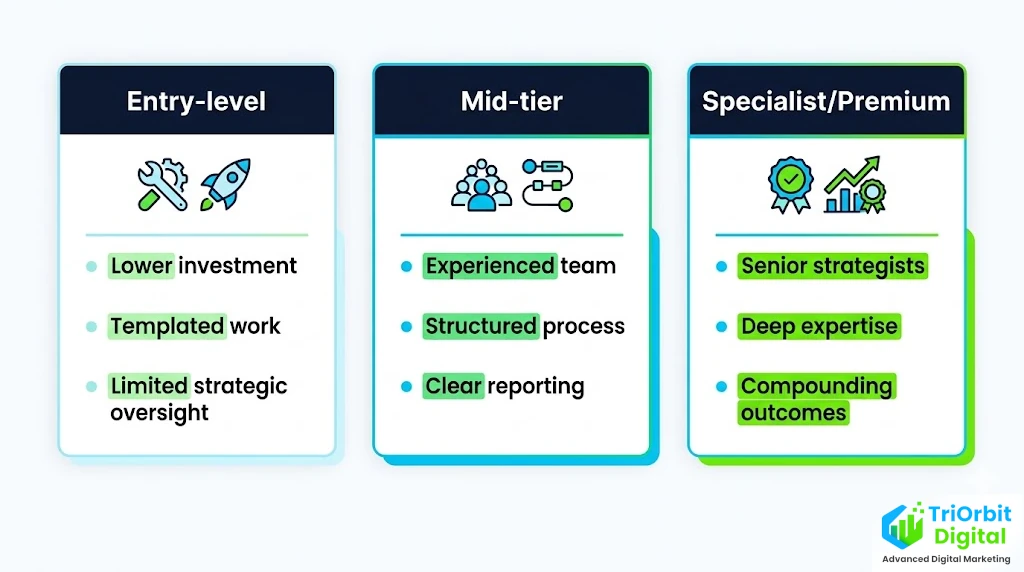
Agency fees generally fall across three broad tiers, each reflecting a different level of capability, experience, and service depth:
- Entry-level agencies: lower monthly investment, typically narrower scope, less experienced practitioners, or high client volumes that limit time dedicated to each account.
- Mid-tier agencies: broader service capability, more experienced team members, structured processes, and reporting that connects activity to real business outcomes.
- Specialist or premium agencies: deep expertise in specific disciplines, senior-level strategic oversight, and a higher investment justified by measurable, compounding outcomes over time.
Alongside the monthly retainer, factor in setup costs for onboarding, technical audits, and initial strategy — most reputable agencies charge separately for this foundational work rather than absorbing it into the retainer and delivering it poorly. The right question to ask is not “what is the cheapest option?” but “what investment level produces the business outcomes I need?” These are fundamentally different questions and lead to very different decisions.
Why the Cheapest Digital Marketing Agency Is Rarely the Right Choice
The cheapest digital marketing agency almost never delivers value proportionate to what you pay. It costs more over time — through months of limited progress and the remedial work required before a stronger agency can begin building on solid ground.
Cheaper agencies typically achieve low prices by:
- Templating or automating deliverables: content, strategies, and reports replicated across accounts rather than built for your specific business situation.
- Using inexperienced practitioners: junior staff managing client accounts without meaningful strategic oversight or quality control.
- Narrowing scope without disclosure: delivering a fraction of what was implied while technically meeting the letter of a vague contract.
- Skipping strategy entirely: executing tasks without a coherent rationale, producing visible activity without measurable direction.
This is not an argument for the most expensive agency. Price is one input in a decision that should be driven primarily by fit, capability, and transparency. A mid-range agency that clearly understands your business, communicates consistently, and follows a structured process will outperform a low-cost agency in almost every comparison — and the gap widens the longer the engagement runs.
Are Digital Marketing Agencies Worth It? That Depends Almost Entirely on Which One You Choose
The right digital marketing agency is absolutely worth the investment. The wrong one is one of the most expensive decisions a growing business can make. The gap between those two outcomes is not luck — it is the result of choosing carefully.
The answer ultimately depends on three things: the specific outcomes you need, how much time digital marketing takes to do properly — which is more than most business owners expect — and whether the agency you choose can demonstrate a credible, structured path to those outcomes. A poor agency is not worth it at any price. A strong one, aligned to your goals, is one of the highest-leverage investments a growing business can make.
The clearest cases for agency value:
- Your team is at capacity: digital marketing needs to be consistent to compound. An agency provides that consistency without the overhead and lead time of an internal hire.
- You need multiple disciplines working together: SEO, content, paid media, social media management, and email all reinforcing each other requires genuine cross-discipline expertise. An agency gives you that without the cost of building it internally.
- You want strategic guidance, not just execution: the agencies worth working with help you determine which channels to prioritise, in what sequence, and why. That strategic layer determines whether your investment compounds or stagnates.
- You need the right foundations in place efficiently: agencies with established systems and documented processes can move through setup, audit, and initial execution significantly faster than starting from scratch internally.
The agencies that are not worth it execute without thinking. They deliver:
- Reports without insight.
- Activity without strategy.
- Time on retainer without measurable forward progress.
The red flags outlined above are your protection against this.
When evaluating whether an agency is worth the investment, consider what they are actually building for you. Organic search consistently delivers the best conversion results of any digital channel — while AI-driven referral traffic still accounts for less than 1% of total website visits, according to BrightEdge. An agency that prioritises building strong organic visibility is building you a compounding asset — one that outperforms every other channel on the metrics that matter most to a growing business.

There is no universal answer to which is the best digital marketing agency for your business — it is the one whose model, team, and approach align with your specific goals, stage, and working style. The evaluation process outlined in this article is how you find it.
Choosing an Agency Is the Beginning, Not the Finish Line
Signing with a digital marketing agency is not the end of the decision — it is the start of a working relationship that requires active input, honest communication, and mutual accountability from both sides. The businesses that get the most from their agency treat it as a genuine partnership. They engage with monthly reporting, share business context that affects what the agency should be doing, and hold the agency accountable to the outcomes agreed at the start.
Everything used to choose an agency applies just as much once the engagement is underway. A good agency welcomes ongoing accountability. One that resists it is telling you something important.
At TriOrbit Digital, every engagement starts with a structured discovery process — a genuine assessment of the business’s current position and what will move the needle most at each stage, not a pitch for a pre-built package. Backed by decades of hands-on experience across every discipline of digital marketing, the result is a digital growth plan built around your goals, not our service menu. If you are evaluating agencies and want to see what a structured, transparent approach looks like before making a decision, a free strategy call is the right place to start.
Frequently Asked Questions
What is the most important thing to look for when choosing a digital marketing agency?
The most important thing is not a service list or a polished case study deck — it is whether the agency leads with strategy or with tactics. An agency that starts by understanding your business goals, your current position, and your competitive landscape before recommending anything is thinking about your outcomes. One that opens immediately with a package recommendation is thinking about its own revenue.
Beyond strategy, look for transparency. A trustworthy agency can explain what they are doing, why they are doing it, and how it connects to your business goals — in plain language, without jargon. If their reporting requires decoding, that is a warning sign worth taking seriously.
How do I know if a digital marketing agency is genuinely experienced or just good at pitching?
The pitch is not reliable evidence of capability. Most agencies invest heavily in presenting well, regardless of the quality of their actual work. The more useful evidence comes from third-party sources — verified client reviews on platforms like Clutch, case studies with real before-and-after data, and how the agency presents its own brand online.
Ask for specific examples of results in your sector or for businesses at a similar stage. An agency with genuine experience will have concrete examples. One without will generalise, deflect to broader claims, or reference results from entirely different industries as if they were equivalent.
Should I choose a specialist agency or a full-service agency for my business?
The answer depends on where your business is right now. If you have a single clear priority — improving search rankings, running Google Ads, managing social media content — a specialist agency with deep expertise in that channel may be the better fit. They will go deeper, faster, without the overhead of services you do not yet need.
If your business needs multiple channels working together as a coordinated system, a full-service agency with genuine expertise across disciplines is likely more efficient. The risk with full-service is that not all agencies have equal depth across all services — ask for specific evidence of capability in each area you care about, not just a list of everything they claim to offer.
What questions should I ask a digital marketing agency before signing a contract?
Start with the basics of accountability: who specifically will manage your account, what is their experience level, and how many other client accounts do they run simultaneously? Then move to process: what does onboarding look like, what will the first 90 days involve, and how will progress be reported?
Finally, ask about ownership. Who holds the accounts, the data, and the content produced during the engagement? Everything should belong to your business, not the agency. If an agency resists or hedges on this question, it tells you something important about the relationship they are expecting to have with you.
How long does it take to see results from a digital marketing agency?
It depends on what results you need and which channels are involved. Paid advertising can generate traffic within days. SEO and content marketing typically require six to twelve months before significant organic growth is visible, because search engines need time to index, assess, and rank new content at scale.
A well-structured engagement starts with a foundation phase — setting up tracking correctly, conducting a technical audit, and building the strategic base — before moving into content production and ongoing growth activity. Expecting the same timeline from SEO as from paid advertising is one of the most common causes of early frustration with a new agency.
What does a digital marketing retainer typically include?
A monthly retainer varies considerably by agency and scope, but typically covers some combination of strategic oversight, content production, technical maintenance, reporting, and ongoing channel management. The specifics should be clearly detailed in a scope of work document attached to the contract — never left vague.
The more useful question is not what activities are included, but what outcomes the retainer is designed to produce. A retainer that lists tasks without connecting them to measurable business goals gives the agency an easy way to fulfil their obligations on paper without delivering meaningful progress.
How do I know if my digital marketing agency is actually delivering results?
The starting point is access. Your Google Analytics account, search console, and any advertising accounts should be in your name and fully accessible to you at all times — not held behind agency logins. If you cannot see your own data independently of the agency, that needs to change immediately.
Once you have access, look beyond surface metrics. Traffic volume and impressions are easy to inflate without generating any business value. The meaningful signals are trends in qualified enquiries, keyword rankings for commercially relevant terms, and conversion performance. A good agency connects every metric in their report to a business outcome. One that cannot is not measuring what matters.
Is a smaller digital marketing agency better than a larger one?
Neither is inherently better — the relevant factors are expertise, direct access, and fit. A large agency may have more resources but may also assign your account to junior staff while senior people focus on winning new business. A small agency may offer direct access to highly experienced practitioners who do the work themselves.
The question to ask is not how many people work at the agency, but who specifically will be working on your account day to day. At TriOrbit Digital, clients work directly with senior practitioners who have decades of experience across every discipline of digital marketing — there is no account management layer between you and the person doing the work.
What are the most common mistakes businesses make when choosing a digital marketing agency?
The most common mistake is choosing on price. The cheapest agency is rarely the best value — low fees typically reflect templated work, inexperienced practitioners, or a high client-to-account-manager ratio that limits the attention your business receives. The cost of poor foundations and wasted months almost always exceeds the money saved upfront.
The second most common mistake is skipping due diligence on team structure. It is easy to be impressed by a polished pitch delivered by senior people, only to find that day-to-day account management is handled by someone with six months of experience. Ask specifically who will handle your account before committing to anything.
How much involvement is required from my side when working with a digital marketing agency?
More than most business owners expect — and considerably less than managing it yourself. A productive agency relationship requires you to share business context (upcoming launches, seasonal priorities, changes in direction), engage meaningfully with monthly reporting, and provide timely feedback on strategic or creative work.
The agencies that deliver the strongest results are those where the client treats the relationship as a genuine partnership rather than a hands-off outsource. You are still the expert on your own business — the agency needs that knowledge to do their job properly. If you want to understand what that working relationship looks like in practice, a free strategy call is a straightforward place to start.