

Hiring a digital marketing agency costs $1,500 to $10,000 or more per month for retainer work, depending on scope, channels, and the agency’s experience level. For project work — a website build, campaign, or brand identity — fees range from a few thousand to over $50,000. Strategic work costs more than basic execution, and aaa understanding that difference is where the decision starts.
Key Takeaways
- The $1,500–$10,000+/month retainer range reflects real differences in agency experience, scope, and market competitiveness — not arbitrary markup.
- The four main pricing models are hourly, project-based, monthly retainer, and value-based — retainers are most common for ongoing work, and the model you choose shapes how the agency’s incentives align with yours.
- The management fee and ad spend are two entirely separate budgets — conflating them in a proposal is a common source of budget confusion, and sometimes a deliberate one.
- Organic search accounts for 53.3% of all website traffic — an agency building organic visibility is building a compounding asset that grows in value every month, unlike a campaign that resets when spend stops.
- Before signing anything: get the deliverables list in writing, confirm all accounts stay in your name, and avoid lock-in contracts without defined performance milestones.
Understanding how much digital marketing agencies charge means understanding what you are actually buying. Pricing digital marketing services is not like purchasing a product off a shelf. A monthly retainer bundles strategy, execution, reporting, and ongoing optimisation into a single investment — and the components of that bundle shift dramatically between agencies, pricing models, and business contexts.
The price in online marketing also reflects a maturing and increasingly competitive industry. Agencies that consistently move the needle invest in skilled people, structured processes, and research-grade tools — including purpose-built keyword platforms like LowFruits — and those investments are reflected in their fees. The cheapest option in the market is rarely the most profitable one. Working out how much it costs to hire a digital marketing agency for your specific situation requires understanding what actually drives the cost. This article covers the pricing models agencies use, directional benchmarks for the most common services, the hidden fees that catch buyers off guard, and the questions every business should ask before signing.
What Determines Digital Marketing Agency Pricing
Digital marketing agency pricing is shaped by four intersecting variables:
- The agency’s experience and capability level.
- The scope and complexity of the services required.
- The competitive landscape of your market.
- The geographic location of both the agency and your target audience.
No single factor drives the number in isolation — all four combine to produce the final investment.
What Does a Digital Marketing Agency Actually Do?
A full-service digital marketing agency plans, executes, and optimises everything that generates online visibility and qualified leads. That typically includes SEO, paid search, social media, content creation, email marketing, web development, analytics, and monthly reporting. The breadth of that scope is one of the primary reasons fees vary so widely. A business buying one service is in a fundamentally different engagement from one buying an integrated programme across six channels simultaneously.
Agency experience is the most significant cost driver. A freelancer or small boutique agency may charge $800–$1,500 per month for basic execution. An established full-service agency with senior strategists, structured onboarding, and a verifiable track record typically starts from $3,000–$5,000 per month. The gap is not arbitrary — it reflects the difference between transactional task completion and strategic thinking that compounds over time.
Scope is the second lever. Project complexity is frequently underestimated. A business with a clear offer, a defined audience, and a solid digital foundation is faster and cheaper to grow than one with fragmented messaging, unclear positioning, or a saturated competitive landscape. Agencies price for complexity because complex engagements take longer to research, plan, and execute — and longer to deliver measurable results from.
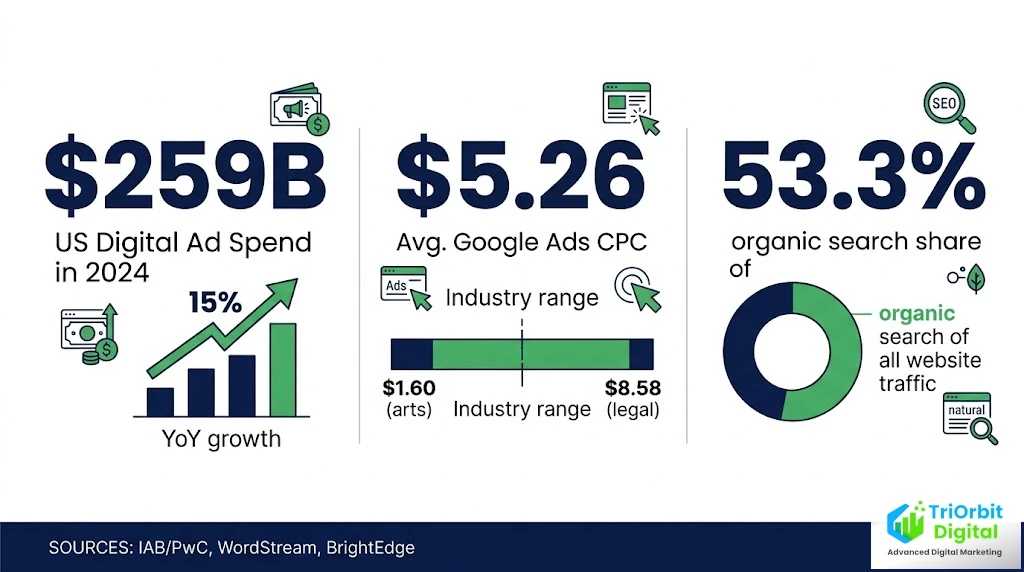
Geographic location affects pricing in two directions. Agencies based in higher-cost markets — major metropolitan cities or regions with strong creative economies — charge more because their overheads are higher. The competitiveness of your own market matters equally. Ranking in a saturated national sector requires more strategic effort and content investment than ranking in a niche or regional one. Industry vertical also plays a role. Legal services, financial advice, and healthcare operate in highly competitive digital environments. Ranking in these spaces requires exceptional content depth and sustained link authority. That drives up the cost significantly — not arbitrarily, but because of what the work actually demands. According to the IAB and PwC, US digital advertising alone generated $259 billion in 2024 — a 15% year-on-year increase. Agencies delivering consistent results in that competitive environment command commensurate fees, and for good reason.
TriOrbit Digital
Not sure what digital marketing should actually cost your business?
A discovery session gives you a clear picture of what a structured digital marketing service with TriOrbit Digital would involve: scope, realistic investment, and what results to expect and when. No one-size-fits-all packages. No obligations.
How Digital Marketing Agency Pricing Packages Work
Digital marketing agency pricing packages bundle services into structured monthly programmes rather than billing for individual tasks. This model gives clients predictable monthly investment and gives agencies the continuity they need to build compounding results over time. Understanding how packages are typically structured is the foundation for comparing proposals accurately.
Most agencies offer tiered packages. The practical differences between tiers come down to three things:
- How much content or activity is produced each month.
- How frequently performance is reviewed and reported.
- Whether a senior strategist is actively involved in ongoing decisions.
Base tiers cover essential services. Mid tiers add execution depth and reporting frequency. Premium tiers provide full-service delivery with dedicated strategic oversight.
Digital marketing pricing packages are structured in two primary ways. The first is fixed-scope — a defined set of deliverables for a fixed monthly fee, with any work outside that scope priced separately. The second is hours-based — a pool of agency time each month, allocated flexibly across services as priorities shift. Fixed-scope works better for businesses with stable, predictable needs. Hours-based suits businesses with evolving requirements across multiple channels.
How Do Digital Marketing Agencies Make Money?
The primary model is the retainer. A digital marketing retainer fee — a fixed monthly fee for an agreed scope of services — is the most common arrangement for ongoing programmes. Beyond retainers, agencies may charge project fees for one-off deliverables, mark up third-party costs such as software licences or ad spend, or use performance-based pricing tied to leads or revenue generated.
The model matters because it shapes incentives. An agency that marks up your ad spend has a financial reason to increase your media budget — regardless of whether the increase benefits your business. A retainer-based agency is incentivised to deliver results that justify renewal. A performance-based agency is focused on the specific metrics the fee is tied to — which may or may not align with the outcomes that matter most to you.
Custom quoting allows for precise scoping. Published pricing sets expectations early and saves time on both sides. Neither is inherently better — the right model depends on how clearly you understand your own requirements before reaching out. What is clear is that agency engagement has become the norm. According to Marketing Week‘s 2025 Career and Salary Survey, 63.1% of marketing professionals outsourced work to an agency or third party in the previous twelve months — up from 46.2% the year before. Knowing how these engagements are structured is no longer optional knowledge.
TriOrbit Digital takes a hybrid approach. Package pricing is published to provide a clear ballpark, with the understanding that scope adjustments shift the final figure. Packages typically start from $1,800 per month, structured across four sequential phases — beginning with the Discovery and Foundations Phase to lay the digital foundation, then visibility, content production, and long-term maintenance — each building on the last. Every engagement runs on month-to-month rolling contracts: no lock-in period, no minimum-term penalty clauses. If results are not there, you can exit without consequence. That structure keeps the agency accountable and gives clients genuine flexibility.
Digital Marketing Agency Hourly Rates and Alternative Pricing Models
Digital marketing agency hourly rates typically range from $75 to $250 per hour, depending on the role, the agency’s location, and the nature of the work. Strategy and senior consultation attract higher rates than execution-level tasks such as scheduling, content formatting, or basic reporting. Hourly billing is one of four common pricing models — and not always the most cost-effective structure for ongoing programme work.
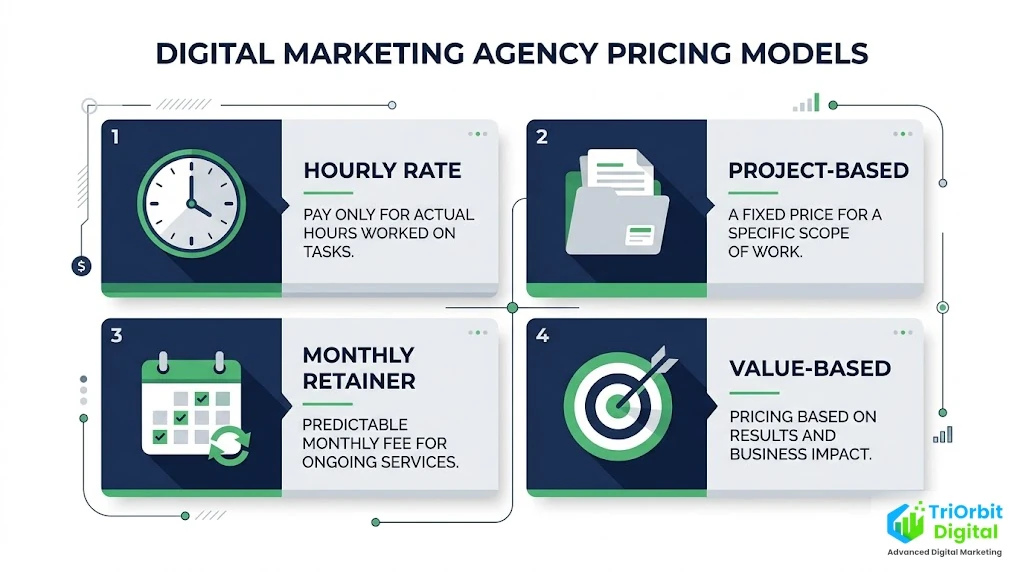
The four models agencies most commonly use are:
- Hourly rate: You pay for time spent. Transparent in theory, but difficult to budget — scope creep is a genuine risk, and the model incentivises effort rather than outcomes.
- Project-based: A fixed fee for a defined deliverable — a website, a campaign, a content series. Well-suited to one-off needs; less suited to ongoing work where compound results are the goal.
- Monthly retainer: A fixed monthly fee for an agreed scope of services. The most common model for ongoing digital marketing engagements. Predictable for both parties and aligned with compounding growth strategies.
- Value-based: The fee reflects the commercial value the work is expected to deliver, not the hours it takes. Common among senior strategists and results-focused agencies. Rewards expertise, not time logged.
Performance-based pricing — where the agency fee is partially or fully tied to outcomes such as leads, conversions, or revenue — is growing in adoption. It aligns agency incentives directly with client outcomes and removes the concern about paying for effort rather than results. It is harder to structure fairly, however, and requires robust conversion tracking infrastructure to work cleanly.
Digital marketing consulting rates for specialist engagements — SEO audits, paid search reviews, strategy sessions — typically range from $150 to $400 per hour for experienced practitioners. Retainer-based consulting, where a senior strategist is available for a defined number of hours each month, generally runs $2,000–$5,000 per month depending on seniority and scope. PPC agency rates are typically structured differently from general hourly rates — most PPC-focused agencies charge a management fee plus a percentage of ad spend, rather than a flat hourly figure.
A Digital Marketing Services Price List by Channel
There is no universal digital marketing services price list. Prices vary by agency, market, and scope. The figures below are directional benchmarks based on industry research. They are starting points for budgeting conversations, not fixed quotes — and actual pricing depends heavily on the specifics of each engagement. All figures are in USD unless otherwise noted.
SEO Services
Monthly SEO retainers for small to medium businesses typically range from $1,500 to $5,000+ per month. Basic packages — keyword research, on-page optimisation, and monthly reporting — sit at the lower end. Full-service SEO — technical audits, content production, link building, and conversion tracking — sits at the higher end. One-off technical SEO audits are typically priced at $1,000–$3,000 depending on site size and complexity.
PPC Management
PPC management fees are most commonly structured as a percentage of managed ad spend — typically 10–20% — with a minimum monthly floor to cover management overhead regardless of budget size. That floor commonly runs $1,000–$2,000 per month. Managing Google Ads and Meta Ads simultaneously typically increases the monthly management fee, as each platform requires its own strategy, creative oversight, and reporting. According to WordStream‘s 2025 Google Ads benchmark report — based on more than 16,000 active US campaigns — the average cost per click across all industries is $5.26. Legal services average $8.58 per click, the highest of any sector. The more competitive your industry, the higher the media spend required to compete — and the larger the management fee that sits on top of it.
Social Media Management
Social media management packages start from around $1,000 per month for basic scheduling and community management across one or two platforms. Full-service packages — content creation, paid social management, reporting, and strategy — typically run $2,500–$6,000 per month. How much a social media marketing agency costs depends heavily on the number of platforms managed and whether paid social campaigns are included in the retainer scope.
Content Marketing
Content marketing — blog articles, pillar pages, email sequences, and downloadable resources — is priced per piece or bundled into a monthly retainer. Individual long-form articles range from $300 to $1,500+ depending on research depth, length, and SEO optimisation applied. A content programme producing four optimised articles per month, inclusive of keyword strategy and performance tracking, typically runs $2,000–$4,000 per month.
Email Marketing
Email marketing retainers for small to medium businesses range from $800 to $2,500 per month. This typically covers strategy, copywriting, template design, send management, list segmentation, and performance reporting. Costs increase with list size, automation complexity, and campaign frequency.
Web Design and Development
Website builds for small to medium businesses start from approximately $5,000 for a straightforward brochure site and scale to $30,000+ for complex sites with custom functionality, eCommerce integration, or advanced performance requirements. Ongoing website maintenance retainers typically run $300–$1,000 per month depending on the level of support included.
Brand Strategy
Brand strategy engagements — covering logo design, visual identity system, tone of voice, and positioning — typically range from $5,000 to $20,000 for a complete project. Brand refresh work for businesses with an existing identity sits at the lower end. Full brand architecture from scratch, including market and competitor research, sits at the upper end.
Digital Agency Fees: What Is Included and What Is Not
Digital agency fees are not always what they appear from the headline monthly figure. The retainer is the starting point — but the real cost of an agency engagement frequently includes additional charges that some agencies disclose clearly and others do not. Mapping the full fee structure before you sign is essential — and often overlooked.
The most common additional charges to watch for:
- Onboarding and setup fees: A one-off charge at the start of the engagement. Sometimes legitimate — for audit work, account configuration, or technical remediation. Sometimes a margin line that is worth negotiating before signing.
- Software and tool subscriptions: Some agencies pass the cost of the tools they use — SEO platforms, scheduling software, reporting dashboards — through as separate line items. Others absorb these into the retainer. Clarify which applies upfront.
- Revision limits: Agencies that cap revisions on creative or content work effectively charge twice for anything requiring more than the included number of rounds. Know the revision policy before briefing any creative work.
- Rush fees: Work needed outside standard turnaround times typically attracts a premium. Reasonable on genuinely urgent requests — a red flag if it appears on work that was scheduled in advance and simply not prioritised by the agency.
- Reporting and admin charges: Monthly reports, strategy sessions, and account reviews should be included in any competent retainer. If they appear as separate invoice line items, push back.
It is also important to separate digital advertising costs — the media spend paid directly to platforms like Google and Meta — from the agency management fee. These are two entirely separate budgets. The management fee covers the agency’s time and expertise. The ad spend goes entirely to the platform. Conflating the two in a proposal is a common source of budget confusion — and in some cases, a deliberate one designed to make the agency’s fee appear smaller than it is.
Ask specifically: what is included in the monthly retainer, what is billed separately, and what is the process when scope changes arise? A transparent agency answers these questions directly and in writing. An opaque one qualifies every answer or defers to a discovery call.
How to Find an Affordable Digital Marketing Agency Without Settling for Less
For businesses searching for the cheapest digital marketing agency, the focus is almost always on the monthly fee. That focus is understandable — but it consistently leads to the wrong decision. The question that actually matters is not “how much does this cost?” but “what return should I expect on this investment, and by when?”
Are Digital Marketing Agencies Worth It?
For businesses that choose the right agency and give the engagement time to work, the return is consistently positive — but timeline is critical. Organic strategies like SEO typically take three to six months before meaningful results appear. Paid search can generate traffic and leads within days. Content marketing compounds over twelve to twenty-four months. Setting realistic expectations before you begin is as important as choosing the right partner. The case for organic investment is particularly strong: according to BrightEdge research, organic search accounts for 53.3% of all website traffic — making it the single largest source of trackable web visits. That traffic is effectively free once earned, compounding in value every month an agency builds and maintains it.
Low cost digital marketing is a relative concept. An agency charging $2,000 per month that generates $20,000 in new business revenue is not expensive — it is a high-return investment. An agency charging $800 per month that delivers no measurable outcome has cost you $800 per month and, more significantly, months of compounding momentum you will not get back. The frame that matters is return on investment, not cost in isolation.
A useful calculation before committing: what is one new client worth to your business over twelve months? If one client is worth $5,000 and a well-run digital programme generates five new clients per month, a $3,000 retainer is returning more than eight times its monthly cost. Running that calculation for your specific business, before setting a budget ceiling, often reveals that the genuinely affordable option is not the one with the lowest fee.
Is Digital Marketing Expensive Compared to Alternatives?
Relative to traditional channels — broadcast advertising, print, trade shows, or cold outreach at scale — digital marketing is generally more measurable, more adjustable in real time, and more compounding in its long-term effects. The concern is not the cost; it is the opacity that too often surrounds it. A business that understands exactly what it is investing in, and can trace that investment to specific outcomes, is never overpaying. One that cannot connect monthly fees to measurable business results is paying blind — regardless of the figure on the invoice.
Warning Signs You Are Being Overcharged
Not every agency delivers value commensurate with its fees. Some rely on client inertia — the tendency to keep paying rather than absorb the friction of switching — rather than on demonstrable results. The following signs warrant a direct conversation, or a decision to look elsewhere.
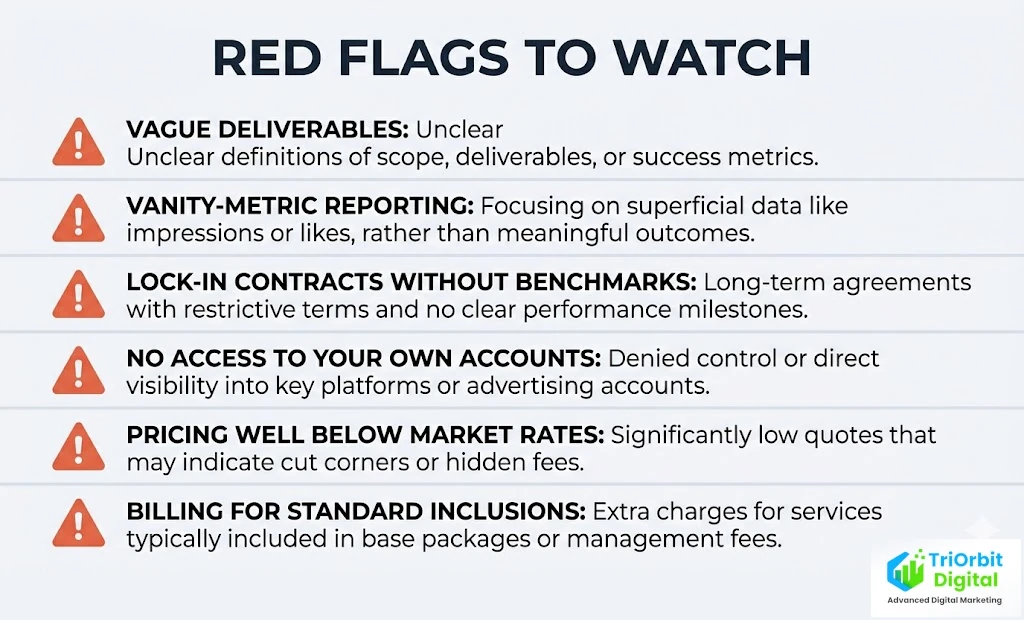
- Vague deliverables: If you cannot clearly state what the agency produces each month and how each output is measured, you do not have a clearly scoped engagement. Every retainer should define deliverables with measurable outcomes attached.
- Vanity-metric reporting: Monthly reports built around impressions, reach, and follower counts — without connecting activity to traffic, rankings, leads, or revenue — are not reporting. They are noise designed to resemble progress.
- Lock-in contracts without performance benchmarks: Agencies that insist on twelve-month lock-in contracts with no defined performance milestones are protecting their revenue at the expense of your flexibility. A confident agency stands behind rolling agreements.
- No access to your own accounts: Your Google Ads account, Analytics property, Search Console access, and social media profiles belong to you — always. If the agency manages these without granting you admin access, resolve that before committing any further spend.
- Pricing well below market rates: Unusually low pricing is as concerning as unusually high pricing. Below-market rates are typically sustained by reducing research depth, skipping strategy, or using undisclosed offshore outsourcing.
- Billing for standard inclusions: Monthly reporting, strategy sessions, and account reviews should be core service delivery. If they appear as separate invoice line items, the retainer is not what it was presented to be.
Seeing one of these signs does not automatically confirm overcharging — it means the conversation needs to happen. A good agency welcomes scrutiny. One that becomes defensive when asked to justify its value has already indicated the answer.
Questions to Ask Before You Sign With a Digital Marketing Agency
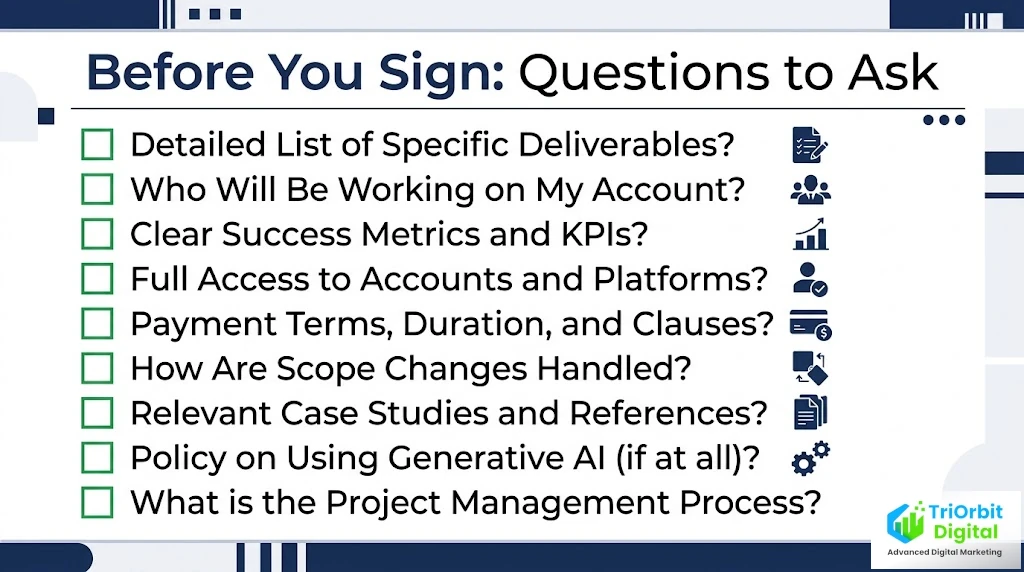
The proposal stage is the clearest window into how an agency actually operates. These questions should be asked — and answered in writing — before committing to any engagement. Pay as much attention to how they are answered as to what the answers contain.
- What does the monthly retainer specifically include? Request a written deliverables list — volume of content, reporting frequency, channels managed, and any explicit exclusions from scope.
- Who will actually work on my account? Many agencies sell on the strength of senior team members and deliver through junior staff. Know who does the day-to-day work and what their experience level is.
- How do you measure success, and what happens if targets are not met? Transparent agencies define success metrics before the engagement begins and are willing to discuss accountability if those metrics are not reached.
- What access do I retain to my own accounts? Google Ads, Analytics, Search Console, and social media profiles should remain under your ownership throughout and after the engagement — without exception.
- What are the contract terms? Is there a minimum commitment period? What are the exit terms? What notice period is required to cancel?
- How do you handle scope changes? If additional work arises mid-engagement, what is the process for pricing and approving it?
- Can you show results for businesses similar to mine? Platforms like Clutch aggregate verified client reviews and case studies — useful for cross-referencing what an agency claims against what clients report. Look for specificity: starting conditions, strategy applied, and measurable outcomes.
- How do you use AI in your delivery? The honest answer is that AI is a productivity tool, not a replacement for strategic thinking. Any agency claiming AI makes their work substantially cheaper without affecting quality deserves careful scrutiny.
- How do you manage client projects and communications? Agencies that use structured project management tools — such as ClickUp — typically offer better transparency around task progress, deadlines, and accountability than those relying on email threads alone.
Researching an agency on LinkedIn before the proposal stage is also worthwhile. Team profiles, tenure, and professional experience give you a clearer picture of the people who will actually be working on your account than any agency website can provide.
This is why a digital marketing agency with clear accountability structures is worth investing in carefully — and why the vetting process is not bureaucracy but the most important filter in the entire decision. An agency that is specific, comfortable with scrutiny, and honest about limitations is worth paying for. One that is vague, defensive, or dependent on jargon to describe its work is not.
Making the Right Investment in Your Digital Marketing
The question of how much it costs to hire a digital marketing agency has a useful answer and a truthful one. The useful answer is a range: typically $1,500 to $10,000+ per month for ongoing retainer work, with project fees varying by scope. The truthful answer is that cost matters far less than value — and value is determined by the clarity of the agency’s strategy, the integrity of their pricing model, and their willingness to be held accountable for measurable results.
The businesses that get the strongest return from digital marketing are not the ones that spend the most. They are the ones that invest in agencies that are transparent about what they do, accountable for what they deliver, and honest about realistic timelines. Those businesses compound their results over years rather than months and consistently outperform competitors who cycle through short-term agency relationships in search of a lower rate. Sustainable digital growth is a function of consistent, structured effort — not of finding the lowest price in the market.
If you are ready to understand what a structured digital marketing investment would look like for your specific business — scope, realistic costs, and what results to expect and when — a free strategy call with TriOrbit Digital is the logical next step. The conversation starts without obligation and ends with a clear picture of what serious, sustained digital growth actually involves.
Frequently Asked Questions
How much should a small business budget for digital marketing?
For most small businesses entering the market with a structured approach, a realistic starting budget is $1,500–$3,000 per month for foundational services — keyword research, on-page SEO, basic reporting, and Google Business Profile optimisation. A full-service programme covering multiple channels typically requires $3,000–$6,000 per month or more, depending on competitive intensity and the number of channels involved.
The most important principle is to start with what you can sustain for at least six months. Digital marketing is a compounding investment — stopping too early because of budget pressure produces no return. A smaller, consistent budget held over twelve months almost always outperforms a larger budget abandoned after three. TriOrbit Digital’s entry-level engagement is structured specifically for businesses that want to build digital foundations before committing to a full ongoing programme.
What is the difference between a retainer and project-based pricing?
A retainer is a fixed monthly fee for an ongoing scope of work — the agency delivers a defined set of services each month, and the relationship continues as long as the engagement is active. It suits activities like SEO, content marketing, social media, and paid advertising, where results compound over time and continuity matters.
Project-based pricing covers a one-off deliverable — a website build, a brand identity, a campaign, or an audit. The agency scopes the work, quotes a fixed fee, delivers the output, and the engagement ends. It suits discrete, clearly defined needs rather than ongoing growth programmes. Many businesses start with a project and move into a retainer once they have a foundation to build from.
How long does it take to see results from a digital marketing agency?
It depends on the channel. Paid search (Google Ads, Meta Ads) can generate traffic and enquiries within days of a campaign going live. SEO typically takes three to six months before meaningful ranking improvements appear, and six to twelve months before the full compounding effect is visible. Content marketing and link building operate on an even longer horizon — twelve to twenty-four months for the strongest results.
Starting point matters too. A business with an established website, existing domain authority, and a clear audience will see results faster than one building from scratch. A good agency will tell you this upfront and give you realistic timeframes before you commit. Be cautious of any agency that promises fast SEO results — it almost always signals low-quality tactics that create problems later. A structured visibility programme sets milestones and tracks progress month by month so you are never guessing.
Is it better to hire an agency or build an in-house marketing team?
For most small to medium businesses, an agency is the more cost-effective option in the early stages of growth. A single mid-level in-house marketer costs $60,000–$90,000 per year in salary alone — before tools, training, management overhead, and the gaps in specialist knowledge that one person cannot fill. An agency at $3,000–$5,000 per month gives you access to a team with expertise across SEO, paid search, content, analytics, and strategy simultaneously.
In-house becomes more compelling once a business has scaled to the point where it needs dedicated brand knowledge, daily responsiveness, and tight integration with product or sales teams. Even then, most businesses retain at least some agency support for specialist functions. The two models are not mutually exclusive — many businesses run a hybrid, with an in-house generalist managing day-to-day and an agency handling the technical and strategic heavy lifting.
What should a digital marketing agency contract include?
At minimum, a contract should specify the exact scope of deliverables each month (volume, type, and frequency), the reporting schedule and what metrics will be reported, who owns the accounts and data at the end of the engagement, the notice period required to cancel, and how out-of-scope work is requested and priced.
Beyond the basics, look for clarity on revision policies, who is responsible for third-party costs (ad spend, software licences), and what happens if a key team member leaves the agency. Any contract that is vague on deliverables or silent on data ownership is worth reviewing with a commercial adviser before signing. The specificity of a contract is often the clearest signal of how seriously an agency takes accountability.
Why do many digital marketing agencies not publish their pricing?
The most legitimate reason is that scope varies so significantly between clients that a published price would be misleading. An SEO retainer for a three-page service website and an SEO retainer for a national ecommerce store with thousands of product pages are entirely different engagements — giving them the same price tag would be inaccurate for one party or the other.
The less legitimate reason is that opaque pricing gives agencies more flexibility to charge different clients different amounts for the same work, and to present proposals in ways that obscure the true cost. This is why the industry is slowly moving toward hybrid models — published package pricing to set expectations, with scope-based adjustments disclosed clearly. If an agency refuses to give you even a directional ballpark before a discovery call, that warrants some caution.
Can you negotiate pricing with a digital marketing agency?
Yes — and the best way to do it is through scope rather than rate. Asking an agency to reduce its hourly rate or margin is rarely productive and tends to create resentment. Asking what can be removed or deferred to bring the investment within budget is a more constructive conversation and one that most agencies are willing to have.
Common adjustments include starting with fewer channels and adding more as results build, reducing reporting frequency in early months, or phasing a larger project over two quarters instead of one. If you are unsure what is essential and what is optional for your situation, a strategy conversation before any proposal is the most useful starting point — it gives you the context to negotiate from an informed position rather than guessing at what to cut.
How do I know if my digital marketing agency is delivering results?
Monthly reporting should connect agency activity directly to business outcomes — not just to output metrics. A good report shows organic traffic trends, keyword ranking movements, leads or enquiries generated, conversion rates, and, where possible, revenue attributed to digital channels. If your monthly report shows impressions and follower counts but no traffic, no rankings, and no leads, it is not a performance report — it is a vanity summary.
Beyond the report, you should have access to your own accounts at all times. Being able to open Google Search Console, your analytics dashboard, and your ad accounts independently — without waiting for the agency to share data — is the baseline standard for any transparent engagement. If the agency controls your access, they control your visibility of their performance.
What is performance-based pricing and is it right for my business?
Performance-based pricing ties part or all of the agency fee to a specific outcome — most commonly leads generated, sales made, or revenue attributed to the agency’s work. It aligns the agency’s financial interests directly with yours and removes the concern about paying for effort that produces no results.
It works best when two conditions are met: robust conversion tracking is already in place, and the agreed metric is one the agency can meaningfully influence. If your tracking is incomplete or the attribution model is unclear, performance-based pricing creates disputes rather than alignment. It also tends to suit businesses with higher-value, clearly trackable conversions — ecommerce transactions, booked appointments, or qualified enquiry forms — rather than broad brand awareness goals.
What is the best way to protect myself when signing with a new agency?
Three things protect you most effectively. First, get the deliverables list in writing before you sign — not in general terms, but specifically: what will be produced, how often, and how it will be measured. Second, ensure all accounts — Google Ads, Analytics, Search Console, social profiles — are set up under your ownership, with the agency added as a user rather than as the owner. Third, avoid long lock-in contracts without defined performance milestones. Month-to-month or quarterly rolling agreements keep the agency motivated and give you a clear exit if the relationship stops delivering.
Agencies that are confident in their work have no reason to resist any of these conditions. Those that push back on account ownership or insist on lock-in clauses without performance accountability are flagging the very concerns you should be protecting yourself against.